
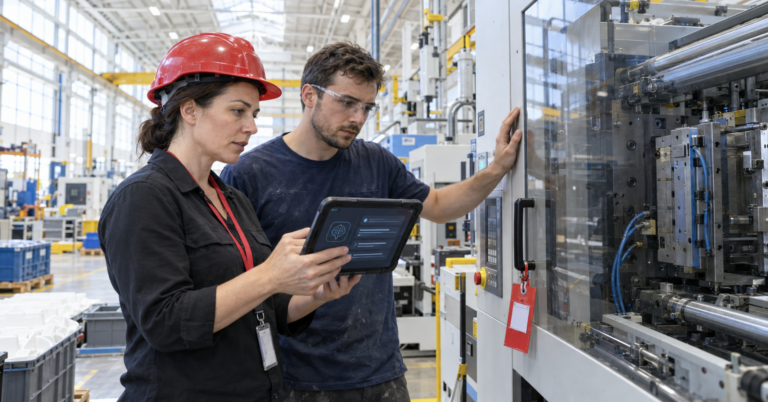
AI training for manufacturing workers usually teaches people how to ask a question. It rarely teaches them what to do when the answer is wrong, and on a shop floor, that is the skill that matters.
The Answer Was Confident and Two Years Old
Priya finished the plant’s AI course on Thursday. Two hours, a certificate, a slide on writing good prompts.
On Friday she asked the plant’s AI assistant for the mold-change sequence on press 6. It answered at once, in clean numbered steps, from a revision two years old.
Her crew had changed that sequence three times since. The assistant didn’t know, and nothing in the course had told her how to spot that. She knew the answer was off only because she has run that press for years.
This Isn’t a Priya Problem
Many plants that roll out AI will meet the same moment. The tool is fluent, the document under it is stale, and the person asking has to decide which to trust.
The data suggests plants aren’t ready for that moment. In the 2026 PwC and Manufacturing Institute report on frontline leadership, 49% of respondents said existing training programs do not prepare frontline employees for AI-driven role changes at all. And 54% reported low or very low confidence in their frontline leaders’ readiness to lead AI-driven change. The respondents were more than 100 manufacturing leaders in operations, HR and executive roles, according to the Institute’s press page, so these are leader perceptions from a small sample, not worker measurements. Still, the direction is hard to miss.
Money is starting to move toward the problem. In April 2026, Google.org committed $10 million to help The Manufacturing Institute equip 40,000 current and future manufacturing employees with critical AI skills. The announcement describes courses and apprenticeship expansion. Whether those courses teach workers to correct the tool is not something it addresses.
What Does AI Training for Manufacturing Workers Usually Teach?
A typical program covers three things.
- Literacy. What AI is, what a model can and can’t do.
- Tool use. How to write a good prompt and where to click.
- Safety and policy. What data stays out of the tool.
All three are reasonable. But all three treat the worker as a user. None treats the worker as the source. Yet the most valuable thing in the interaction on press 6 was Priya’s knowledge, and the training gave her no way to put it back into the system.
Why Does an AI Assistant Get the Job Wrong?
Because it reads the document, and the document drifted.
An assistant can only be as current as what it was given. If the SOP is two revisions behind the real sequence, the assistant will deliver the old sequence faster and more politely than any binder ever did. We wrote about how often procedures should be refreshed in how often should manufacturing SOPs be reviewed, and the same logic applies here: a faster reader of a stale document is not an improvement.
The second cause is variation. When two operators run the same job two ways, the assistant picks one. Our piece on operator to operator variation explains why the better method is often the one nobody wrote.
How Do You Train Frontline Workers to Use AI?
Train them on a job they already know, and give them the right to say the machine is wrong.
Here is a way to do that, in four moves:
- Start with the person’s own job. People trust their own corrections. Don’t start with a generic exercise about a spreadsheet.
- Make the correction the lesson. Every time the tool is wrong, the fix gets recorded. That is the exercise, not a failure of it.
- Give them protected time. Thirty minutes on the floor, not a module at a desk after shift.
- Put a supervisor in the lead. The person who validates the answer should be the person who owns the job.
The PwC and Manufacturing Institute report points the same way. It says AI capability building must combine formal instruction with structured experimentation, with protected time to test AI in real workflows. Its “earn trust” condition calls for involving frontline leaders early. In our experience, when people help shape the system, they stop treating it as something done to them.
What the Market Sells Instead
Mostly more courses. A certificate for every worker. A dashboard that shows who finished the module. An assistant that summarizes a binder that was never accurate to begin with.
Each of these measures exposure. None of them checks whether the worker can tell when the answer is wrong, or gives the worker a way to fix it for the next person. A course ends. A correction stays in the system.
What Does a Supervisor Learn When They Lead the Capture?
More than they would in a classroom. At SenseiLab, we train a supervisor or engineer on your own team to lead the AI-assisted capture of a job. They walk the AI through the work, correct what it gets wrong, and validate the finished procedure before it goes to the floor.
That is the first hands-on experience many people have with AI, and it happens on a job they know cold. They learn what the tool is good at, where it needs correcting and how their own judgment shapes the result. And because the standard stays in your hands after we leave, the training has somewhere to live.
Run the Thirty-Minute Correction Test This Week
You can start without us. It needs one supervisor, one SOP and any AI assistant your company already allows.
- Pick one real SOP for a job the supervisor knows well.
- Give the supervisor thirty minutes with the assistant, with that SOP as the source.
- Have them ask three questions whose answers they already know.
- Mark each answer right, wrong or dangerous.
- List every wrong and dangerous answer, with the correction.
You will probably find that the wrong answers cluster around the steps the crew changed informally. That list is your training plan, because it shows what the tool needs from your people. It is also your document backlog, because it shows where the SOP drifted. Our guide to how to train new operators faster shows how to feed the same corrections into onboarding.
Frequently Asked Questions About AI Training for Manufacturing Workers
What is AI training for manufacturing workers?
AI training for manufacturing workers teaches frontline employees how to use AI tools safely and effectively in their jobs. The strongest versions also teach workers to check and correct the tool’s answers using their own knowledge of the job.
How do you train frontline workers to use AI?
Start with a job the worker already knows, give them protected time on the floor, and record every correction they make. Put a supervisor in charge of validating the results so the training builds trust as well as skill.
Why does an AI assistant give outdated answers on the shop floor?
It can only be as current as the documents it reads. If an SOP is behind the real process, the assistant repeats the old method with full confidence.
How do we train new operators faster?
Fix what you teach before you speed up how you teach it. Our article on how to train new operators faster shows how to build training from the best method rather than the written one.
About the author: Diego Echenique, MBA, is CEO & co-founder of SenseiLab, with 20+ years in manufacturing operations. LinkedIn: linkedin.com/in/diegoechenique