
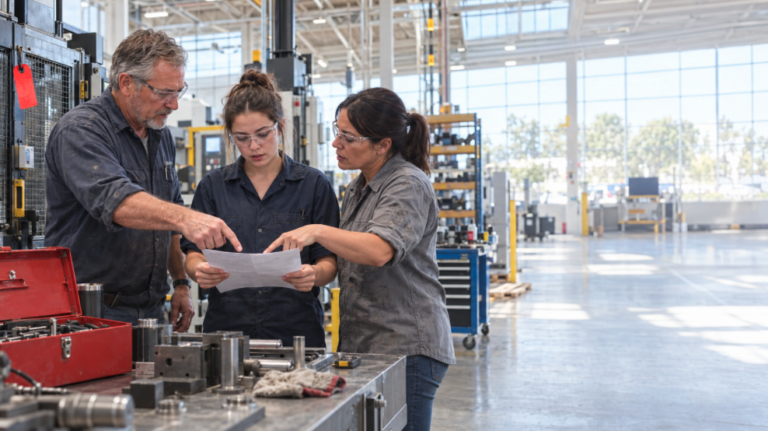
The best trainer on that floor had taught the job eleven times, and he had never taught it the same way twice.
I did not find that out by asking him. I found it out by watching him teach it, and then watching the lead on the opposite shift teach the same job the following week. If you want to know how to train new operators faster, that second hour of watching is worth more than the training platform the plant had just bought. Same machine, same part number, two different jobs. Both of them worked. Neither was written down anywhere.
The plant was six weeks into a program to shorten new-hire ramp-up. Curriculum, platform, assigned mentors. What nobody had checked was whether the two mentors agreed.
Why do two qualified trainers teach the same job differently?
Because what sits in a trainer’s head is not curriculum. It is twenty years of accumulated correction: the workaround for the fixture that lies to you, the alarm that is real and the alarm that is noise, the moment in the run when you can still pull a bad part back.
That knowledge was earned privately and it is held privately. Every trainer owns a different parcel of it, and none of the parcels is written down, so there is no mechanism by which they could ever converge.
Pairing a new person with a good one is the oldest training method in industry and it is a sound one. It works when the good one has a single agreed version of the job to teach. Almost nobody does.
How do we train new operators faster?
Fix what is being taught before you change how it is taught. A new hire reaches productive output when she stops receiving contradictory corrections, and contradictory corrections come from trainers working off different unwritten versions of the same job. Capture the judgment each trainer is carrying, reconcile where they disagree, and train from the reconciled version. The training method itself is rarely the constraint.
That answer is unsatisfying, because it means the platform is not the lever. It also means the first fix costs nothing.
Why does the ramp take so long even with a work instruction?
Watch a new hire in week three and count her corrections. Most of them are not corrections of error. They are corrections of version. She was shown one way on Tuesday. On Thursday somebody tells her that is not how we do it. The following Monday a third person tells her to ignore the second person.
Every one of those exchanges costs her confidence and costs the plant output, and none of them appear in a training record, because the record says she was signed off on day nine.
It is the same structural gap that shows up as shift-to-shift variability once she is qualified and running alone, and it is why a manufacturing skills matrix can show a plant fully covered while the floor knows perfectly well that two of the green boxes are nothing like each other.
What happens when the hiring wave arrives?
Deloitte and The Manufacturing Institute published an analysis on September 10, 2026 estimating that manufacturing technician employment could grow six times faster than production occupations in manufacturing between 2025 and 2030, and that employers may need to fill 2.3 million job openings across manufacturing and adjacent-industry technician occupations in that same window, driven by growth, retirements, other labour-force exits and occupational transfers. The same analysis identifies nearly 2 million technicians in adjacent industries whose broad skills may be transferable into manufacturing.
Read those as projections, because that is how the publisher frames them. Read the implication as certain anyway: a large share of the people who will run your processes in 2030 are not in your industry today. They will arrive with real skill and none of your plant’s unwritten history, and they will be trained by whoever happens to be free that week.
The earlier 2024 Deloitte and Manufacturing Institute study, Taking charge, put the broader figure at as many as 3.8 million new employees needed between 2024 and 2033, with as many as 1.9 million of those roles potentially unfilled. Everyone quotes the hiring gap. The quieter problem is what happens to the ones you do hire.
What is the market selling for faster operator training?
Delivery mechanisms, almost exclusively. Augmented reality overlays. Adaptive training systems. Video work instructions. Platforms with sign-off workflows. Every one of them is a better pipe, and some of them are very good pipes.
None of them fills the pipe. They all assume the content going in is correct, complete and singular, and in most plants it is none of the three. A video of the wrong version trains the wrong version faster.
The ninety-minute second-trainer test
No budget, one job, two people who already work for you.
- Pick a job with more than one qualified trainer, ideally one where the ramp has been painful.
- Have your best trainer teach it start to finish, exactly as he would to a new hire, while a third person writes down only the judgment calls. Not the steps. The decisions: what he listens for, when he backs off, which dimension he checks before the sheet tells him to, what makes him stop and re-set.
- Print that list. Hand it to your second-best trainer, on another shift if you can.
- Ask him which of those calls he would make differently, and which ones he has never made at all.
- Sit them down together and settle each disagreement, one line at a time.
The list you end up with is the real curriculum. Everything your new hire currently absorbs one correction at a time is sitting on that page instead, in writing, before her first shift.
The step-by-step procedure was never the hard part. Your work instruction probably has the steps. What it does not have is the judgment, and judgment is the entire difference between a person who can run the job and a person who is still asking.
What if you have fifty jobs and not one?
The ninety-minute version handles a single job. A plant has dozens, and the bottleneck stops being method and starts being capacity.
That is the work SenseiLab does in the 30-day SOP Sprint. The experienced people — operators, leads and supervisors — put their version of the job into an AI agent in their own words, and then one internal champion is trained and equipped to keep the resulting procedures current after we leave. The upskilling that matters most is not the new hire’s. It is the supervisor who can now maintain the standard without us. It is the same knowledge-capture logic behind documenting tribal knowledge in a plant, pointed at the ramp.
Your training method is probably fine. What you are teaching is the problem.
Book a 30-minute SOP Readiness Diagnostic: senseilab.io/book-a-call
FAQ
How do we train new operators faster? Fix what is being taught before changing how it is taught. Most ramp time is spent absorbing contradictory corrections from trainers who each hold a different unwritten version of the job. Capture one trainer’s judgment calls, have a second trainer mark the ones he would make differently, and reconcile them into a single version to train from.
Why do new hires take so long to reach full output even with a work instruction? Because the work instruction covers the steps and not the judgment. The decisions that separate a competent operator from a slow one, such as when to back off and which alarm matters, are usually unwritten and get transferred person to person, inconsistently.
Does training software shorten new-hire ramp-up? It shortens delivery, not learning. Video, AR and LMS platforms move content to the floor faster, but they assume the content is correct and singular. If two trainers disagree about the job, digitising one of their versions only spreads it faster.
How do I measure whether onboarding is actually improving? Stop counting days to sign-off and start counting corrections per shift in weeks two through six, separating corrections of error from corrections of version. A falling version-correction count means the underlying standard is converging; a flat one means you changed the pipe rather than the content.
Author bio
Diego Echenique is CEO and co-founder of SenseiLab, a knowledge capture and operational excellence firm in Aventura, Florida. He has spent more than 20 years in manufacturing operations across automotive, mining and heavy industry, launching plants and leading Lean and Six Sigma transformations in Argentina, Chile, Europe, the Middle East and Asia.