
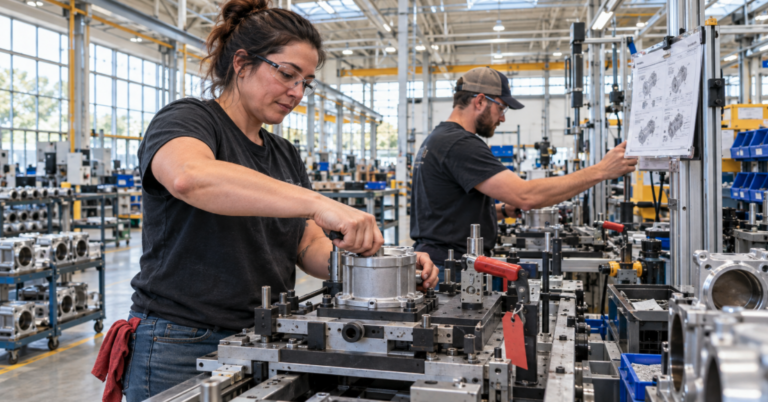
Two operators can run the same job, off the same work instruction, on the same shift, and hand you different results. That gap is operator to operator variation, and it isn’t always the problem it looks like. Sometimes it is the best method in your plant, running quietly in one person’s hands.
Two Operators, One Fixture, Fourteen Seconds Apart
Nadia and Pedro ran the same fixture on second shift at a supplier plant I was visiting for Renault-Nissan. Same work instruction, laminated and clipped to the rail. Same housing, same torque spec.
Nadia’s cycle ran fourteen seconds faster than Pedro’s. Her parts never came back. I timed thirty-one cycles of each, because the first few didn’t seem believable.
Pedro followed the sheet line by line. Nadia skipped the re-seat step, reordered two others, and added a quarter-turn of the wrist the sheet never mentions. That quarter-turn seated the part the first time, so the re-seat was redundant for her. Nobody had told her to do any of it. Nobody had asked her why.
Is This Just a Nadia Problem?
No, and that is the point. Every plant I’ve walked has a Nadia and a Pedro, and most don’t know which is which.
Researchers have measured this. A field study of production task cycle times, published in The International Journal of Advanced Manufacturing Technology, found that “worker performance varies significantly, much more than is assumed by contemporary manufacturing system designers.” Earlier work by John Buzacott in the International Journal of Production Economics went further. In any group of workers doing apparently identical tasks, he wrote, the differences “increase with the cognitive complexity of the task and persist even when considerable experience in the job has been accumulated.”
So experience doesn’t close the gap. Neither does time on the job. That matters, because it rules out the most common fix.
Why Do Two Operators Get Different Results From the Same SOP?
Because the SOP describes the steps someone wrote down, and every operator fills the gaps with their own judgment.
A work instruction is a short document describing a long job. Between “seat the housing” and “torque to spec” there are a dozen small decisions: how hard to press, which way to turn, when it feels right. The sheet is silent on all of them, so each person invents an answer. Most answers are fine. A few are better than the document. A few are quietly worse.
That’s why the variation shows up even on a well-written SOP. The document wasn’t wrong. It was incomplete, and the floor completed it differently in every pair of hands.
What Retraining Gets Wrong About Operator to Operator Variation
Retraining is the standard response, and it aims at the wrong target. It teaches everyone the sheet. Pedro already follows the sheet, so he learns nothing. Nadia, who departs from it, gets pulled back toward it. The best method on the floor gets trained out.
The market makes the same mistake at scale. Dashboards flag the outlier operator as the exception to manage. Training modules rehearse the written steps. Standard-work posters go up on the wall. All three treat the document as the truth and the person as the deviation. In Nadia’s cell, the deviation was the improvement.
Three Kinds of Operator to Operator Variation
Not every difference deserves the same response. When you watch two people closely, the gaps sort into three piles:
- Better. The method is faster or more reliable and should become the standard. Nadia’s quarter-turn lives here.
- Riskier. The method saves time by cutting something that protects quality or safety. These need to be fixed, and quickly.
- Neutral. The two methods differ in style and produce the same result. Leave them alone, and don’t spend a supervisor’s attention on them.
The hard part is that you can’t sort what you haven’t seen. And nobody has ever asked Nadia to narrate her hands.
Run the Two-Operator Delta Test This Week
You don’t need software or a consultant to measure operator to operator variation. Here is the version you can run on Thursday.
- Pick one job with a written instruction and at least two people who run it on the same shift.
- Time three full cycles for each operator, and watch their hands, not the clock.
- Write down every point where the two methods differ. Skipped steps, extra steps, a different order, a different grip.
- Ask each operator why they do it that way. Ask Nadia the same question you ask Pedro, and write down the answer as she says it.
- Sort each difference into better, riskier or neutral. Do this with the supervisor in the room.
- Take one “better” difference and have both operators run it for a week. Compare cycle time and first-pass results.
The count of differences will vary by job. Even one “better” difference is worth the hour, because it is a method your best person has been running for free.
How We Capture the Best Method on Your Floor
That test is the five-minute version of what we do on a floor. SenseiLab’s 30-day SOP Sprint puts our team next to your most experienced operators in Week 2 for recorded capture sessions. We record where their hands depart from the written sheet, structure it into a draft, and have the supervisor validate each change before it becomes the standard. A supervisor from your team is trained to extend the work after we leave.
The method that used to live in one person’s hands then lives in the document everyone opens. If you want the longer version of how to capture it, we wrote it up in how to document tribal knowledge in a plant, and the training side of the same problem is in how to train new operators faster.
Frequently Asked Questions About Operator to Operator Variation
Why do two operators get different results from the same SOP?
The SOP only describes the steps that were written down. Each operator fills the unwritten gaps with their own judgment, so two good people produce two methods and two sets of results.
How can we standardize work across shifts?
Start by finding which method is actually best, then write that down. Standardizing on the document alone locks in the average method, not the best one. Our guide to how to standardize work across shifts walks through the full process.
Is operator to operator variation always bad?
No. Some of it is harmless style, and some of it is your best practice. The risk is leaving it uncaptured, because the better method retires, transfers or quits along with the person who holds it. We covered that exposure in key person risk in manufacturing.
About the author: Diego Echenique, MBA, is CEO & co-founder of SenseiLab, with 20+ years in manufacturing operations.