
Poka yoke in manufacturing is one of the best ideas lean manufacturing gave us, and it has one blind spot. It only protects the errors someone predicted. A step nobody wrote down can’t be mistake-proofed, because nobody knows it is there.
The Fixture Worked. The Seal Still Leaked.
Marcus had been on the machining cell nine days when a housing shipped with an unseated seal.
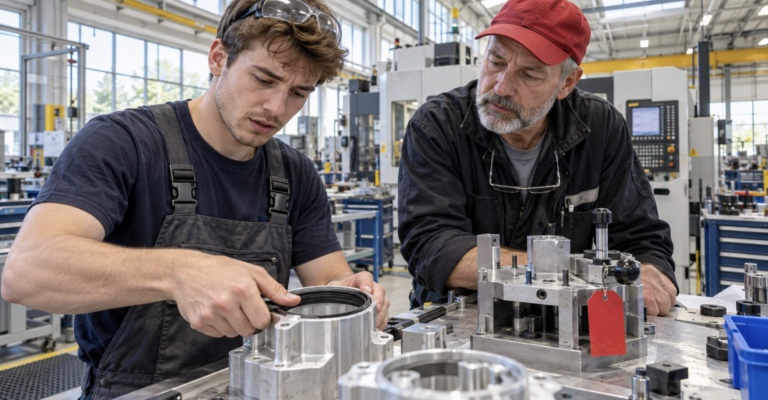
The fixture on his station was error-proofed. It wouldn’t let him load a part backwards, and he never did. The quality review traced the escape to a step the fixture couldn’t see: the thumb-press the third-shift setter gives that seal before the cover goes on. It wasn’t in the work instruction. No sensor checked it. The setter had done it for years without thinking, and Marcus had never watched him do it.
This Isn’t a Marcus Problem
Every plant has a Marcus, and every plant has a setter like that. The fixture isn’t the failure. The fixture did exactly what it was built to do.
ASQ defines mistake-proofing, or poka-yoke, as “the use of any automatic device or method that either makes it impossible for an error to occur or makes the error immediately obvious once it has occurred.” That definition is the strength and the limit at once. A device can only make impossible, or obvious, an error that someone imagined first.
Where Poka Yoke in Manufacturing Stops
The UK’s Health and Safety Executive sorts human failure into types, and the sorting shows where the boundary sits. Slips and lapses, it says, “occur during a familiar task and include slips (eg pressing the wrong button or reading the wrong gauge) and lapses (eg forgetting to carry out a step in a procedure).” Those are the errors poka yoke in manufacturing was made for.
Mistakes are different. HSE describes them as “errors of judgement or decision-making where the ‘intended actions are wrong’ ie where we do the wrong thing believing it to be right.” Its guidance on that category is short: “Training based on good procedures is the key to avoiding mistakes.”
Notice what that sentence assumes. It assumes the procedure is good, and that it contains the step. In Marcus’s cell the procedure was missing the one step that mattered. So there was nothing to train him on, and nothing for a fixture to enforce.
Why Do New Hires Make This Worse?
More new hands means more unwritten steps get missed, because the people who carry those steps are outnumbered. That’s my reading of the pattern, not a finding, but the survey data points the same way. Octave’s 2026 Pulse of Quality in Manufacturing survey, which polled 2,263 managers and directors at manufacturers with 1,000 to 50,000 or more employees in the U.S., U.K. and Germany, reports that 85% say labor and skills shortages are negatively affecting product quality. Octave sells industrial software and sponsored the survey, so read it as an industry sentiment signal, not a measurement of defects.
Even so, the direction is hard to argue with. When experienced people are scarce, every unwritten step is one absence away from an escape.
Three Steps No Fixture Will Ever Check
Here is what unwritten steps look like when you go looking for them:
- The thumb-press on the seal before the cover goes on.
- The “wait for the second click” on a torque wrench that gives a false first click, which a veteran learned to ignore.
- The two taps on a housing before it goes into the washer, so trapped chips drop out of the bore.
None of these is in a document. None can be reached by a sensor you’ve already bought. And every one of them is obvious to the person who does it and invisible to everyone else.
What the Market Sells Instead
The usual answer is more hardware. Another fixture, another vision system, another sensor on the line. Lately it’s an AI watching the line for the errors it was shown during training. All of it protects the steps you already know about, and none of it finds the ones you don’t. The category keeps buying better guards for a gate with a hole in the fence.
Find the Step First, Then Mistake-Proof It
The order matters. First you find the unwritten steps, then you decide which deserve a fixture.
SenseiLab’s 30-day SOP Sprint is built for the finding. We capture how your most experienced people really do the job, validate it with your supervisor, and then train a supervisor or engineer on your own team to lead the AI-assisted capture after we leave. That’s the “Leading with AI” part of the work: the skill ends up on your payroll, not ours. Once a step like the thumb-press is on paper, poka yoke in manufacturing can finally reach it, and the fixture becomes a much simpler job to scope.
Run the Ten-Escape Sort This Week
You can start without us. Here is the sort, and it takes about an hour:
- Pull your last ten quality escapes or customer returns.
- For each one, write down the physical step where it went wrong.
- Ask one question. Could a fixture, sensor or gauge have blocked it?
- If yes, mark it “predictable” and check whether you’ve already built that guard.
- If no, mark it “unwritten.” Go to the operator who runs that step and ask what they do that the instruction doesn’t say.
- Count the unwritten ones.
If the unwritten pile is bigger than the predictable one, you don’t have a mistake-proofing problem. You have a capture problem. Our look at why “human error” fails as a root cause covers the same trap from the corrective-action side.
Frequently Asked Questions About Poka Yoke in Manufacturing
What is poka yoke in manufacturing?
Poka yoke, or mistake-proofing, is any automatic device or method that makes an error impossible or makes it obvious right away, according to ASQ. Examples include a fixture that only accepts a part in the right orientation.
Can poka yoke prevent every operator error?
No. It prevents the errors someone predicted and designed a guard for. Steps that live only in an experienced operator’s habits, like a thumb-press or a second tap, have no guard because nobody has found them yet.
How do we reduce rework or defects caused by inconsistent processes?
Find where the actual method differs from the written one, then fix the document before you add hardware. We walk through the process in how to reduce defects caused by inconsistent processes.
How do we find unwritten steps?
Watch the experienced operator run the job for a full shift and ask why they do each thing. Our guide to how to reduce scrap in manufacturing shows the same method applied to setup.
Forward this to one quality engineer who has been told to “add another poka-yoke.”
About the author: Diego Echenique, MBA, is CEO & co-founder of SenseiLab, with 20+ years in manufacturing operations. LinkedIn: linkedin.com/in/diegoechenique