
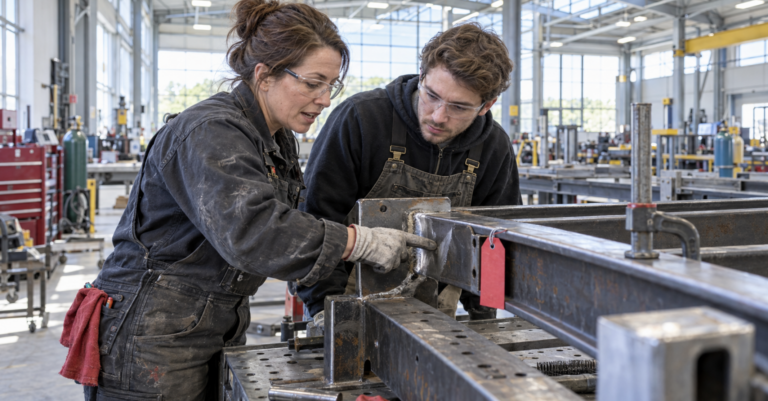
Rework instructions are the least written-down procedures in most plants, and the riskiest. The build has a sheet. The inspection has a sheet. The repair, the step most likely to add a new defect, usually has a sentence.
The Instruction Said “Rework Per Supervisor”
Lucia’s repair on a porous weld takes 22 minutes. The tech on the other shift takes 41, and three of his come back.
I timed both during a visit to a metal fabricator. Same bench, same defect, same part number. The line on the route card said “rework per supervisor.” Four words.
Lucia grinds to bright metal, goes a few millimeters past where the porosity ends, and lets the joint cool before she lays the repair. None of that is written down. Nobody had ever asked her how she does it. They only knew that her parts didn’t come back.
This Isn’t a Lucia Problem
Most plants have a rework bench, and most rework benches have a Lucia. The method lives in her hands, and the document points at whoever is standing nearby.
Repair can add risk the original job didn’t have. A 1983 report by The Welding Institute for the American Institute of Steel Construction warned of “introducing new defects which are more harmful and less readily detectable” than the ones being repaired. It also estimated that unnecessary repair and re-repair typically adds 10% to construction costs. That estimate is about steel construction, so don’t read it as a plant-wide figure. The direction still holds for any floor: repair is where a small defect can become a larger one.
Why Is a Repair Harder to Write Down Than a Build Step?
Because the job changes every time. A build step repeats. A repair depends on the defect, where it sits, and what the part can tolerate.
Three things make that worse:
- The defect varies. Two porous welds are rarely the same depth or length, so the author writes “as required” and moves on.
- The best technician does the repair. The person with the most tacit skill is also the person least likely to be asked to write it down.
- The build document gets the attention. Audits, reviews and training all focus on the main route, so the repair path is treated as an exception.
One welding trade article makes the same point. A November 2025 piece in the American Welding Society’s Welding Digest says: “repair welding often requires a dedicated WPS.” The same logic applies outside welding. A repair is a different job, and it needs its own rework instructions, not a footnote on the build sheet.
What Should Rework Instructions Contain?
A good repair procedure answers five questions in the order the technician meets them:
- Entry condition. What defect qualifies for this repair, and how is it confirmed?
- Removal. How much material comes out, and what tells the technician to stop?
- Repair method. What tool, setting and sequence, and what must happen between passes?
- Re-inspection. What does “good” look like afterward, and who checks it?
- Limit. How many times can this part be reworked before it goes to a different decision?
Most route cards cover the first and the fourth, half-heartedly. The second, third and fifth live in the technician’s head.
How Do You Write Rework Instructions That Operators Can Follow?
Ask the person who does the repair, then watch them do it. Never write the instruction from the quality manual.
Start with a real repair, not a hypothetical one. Have the technician narrate each decision as they make it: why that depth, why that wait, why that angle. Record every “it depends.” Each one marks a decision your instruction has to name.
Then validate it. Hand the draft to a second technician who has never watched Lucia work and count how many times they stop to ask. Every stop is a missing line. That test is the same one we use in our guide on how to document tribal knowledge in a plant, and it works here for the same reason.
What the Market Sells Instead
The usual answer is measurement. Rework dashboards. Defect-code analytics. Software that classifies defects from a photo. All of it counts the repairs after the fact, and none of it writes the repair down.
Counting rework is useful. We covered how to measure rework in manufacturing for exactly that reason. But a tidier count of repairs nobody has standardized doesn’t make the next repair better. It only makes the problem easier to chart.
Let the Repair Technician Explain It to the Agent
This is where capture does the work.
At SenseiLab, the rework technician talks to our AI agent while explaining the repair, the same way Lucia would walk a new hire through it. The agent structures what she says into a procedure, and the supervisor validates it against the real part. She doesn’t learn a new tool, and nobody takes her off the bench for a week to write.
Once the repair is on paper, the rest of your system can finally reach it. A fixture, a gauge or a re-inspection step can be scoped against a method that exists. Our piece on what poka yoke in manufacturing can’t reach explains why that order matters.
Run the Ten-Disposition Audit This Week
You can start without us. It takes about an hour:
- Pull your last ten rework dispositions.
- Read the instruction attached to each one.
- Mark every one that says “per supervisor,” “as required,” or “see engineering” as no method.
- Pick the most frequent repair among them and sit with the technician who does it.
- Ask them to narrate one full repair and write down the entry condition, the stop point, the method, the check, and the limit.
- Compare what you wrote with the instruction on file.
If most of your dispositions land in “no method” (my rule of thumb, not a benchmark), your problem isn’t how much rework you have. It’s that the repair is the one operation nobody has standardized. We pair this with the approach in how to reduce scrap in manufacturing, which applies the same observation to setup.
Frequently Asked Questions About Rework Instructions
What are rework instructions?
Rework instructions are the written steps for repairing a nonconforming part so it meets specification. A complete set covers the entry condition, removal, repair method, re-inspection and a limit on repeat repairs.
How do you write rework instructions that operators can follow?
Watch the technician who does the repair, have them narrate each decision, and record every “it depends.” Then give the draft to a second technician and count how often they stop to ask.
Do repairs need separate instructions from the build?
Yes. A repair is a different job from the original build, with different risks and decisions. A footnote on the build sheet leaves those decisions to whoever is closest.
How do we reduce rework or defects caused by inconsistent processes?
Find where the real method differs from the written one, then fix the document before adding inspection. We walk through that in how to reduce defects caused by inconsistent processes.
About the author: Diego Echenique, MBA, is CEO & co-founder of SenseiLab, with 20+ years in manufacturing operations