Troubleshooting procedures in manufacturing usually list what could be wrong. They rarely record what your best person checks first, which is the part that gets the line running.
Press 4 Was Down for 47 Minutes
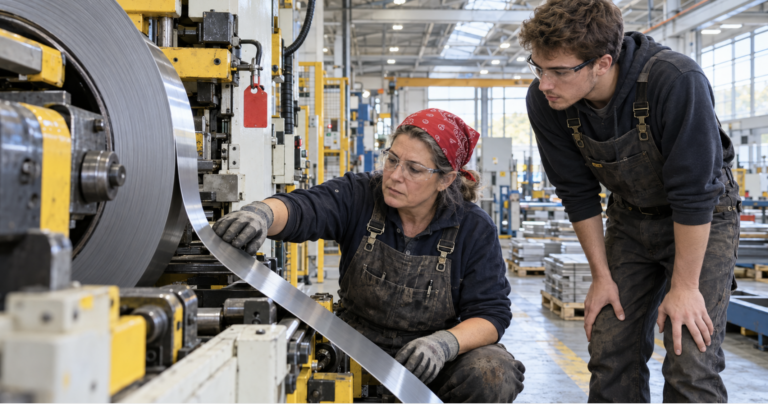
Press 4 had been down for 47 minutes on a misfeed alarm when Inés walked over from press 2.
The operator had followed the procedure exactly. Check the sensor. Check the feed rollers. Reset. Check the sensor again. The alarm came back every time.
Inés didn’t touch the sensor. She looked at the edge of the coil. The strip had a slight camber, and the feed was fighting it. She had the press running in six minutes.
None of that was on the sheet. It listed symptoms and fixes. It didn’t say which check comes first, or what a good setter looks at before she touches anything.
This Isn’t an Inés Problem
Many plants have an Inés, and many know who she is. When she’s on shift, stops are short. When she’s on break, on another line, on leave or promoted, they aren’t.
The numbers are worth a look, with a caveat. L2L’s 2026 manufacturing data report, a survey of more than 600 U.S. manufacturing leaders reports that 88% say critical operational information disappears when experienced employees leave. It also reports that only 9% can find the root cause of a shop-floor issue immediately. L2L is a software vendor and the figures come from its own research, so read them as a signal rather than a census. Even so, they describe something many supervisors have watched: a stop waiting on a person.
What Do Most Troubleshooting Procedures Actually Contain?
Three formats are common.
- A fault-code table. Alarm number, probable cause, suggested fix.
- A flowchart. If the sensor is clear, go here; if not, go there.
- A manufacturer’s manual excerpt. Accurate, and written for every plant that owns the machine.
All three are useful. But all three are written from the machine’s point of view. They list every cause the manufacturer could think of, in an order that makes sense on paper. They don’t reflect your press, your material or your supplier’s last three coils.
Why Don’t Experts Write Down What They Check First?
Because they don’t experience it as a list. Inés doesn’t think, “Step one, inspect strip edge.” She sees a misfeed and her eyes go there, the way a mechanic hears a noise and knows which side of the engine to open.
That is why asking an expert to write the procedure rarely works. We covered the same trap in how to document tribal knowledge in a plant: capture from observation, not from memory. Experts know a great deal, and most of it lives below the level of words.
It also explains the exposure we described in key person risk in manufacturing. A plant isn’t at risk because one person knows more. It’s at risk because the stop waits for that person.
How Do You Capture an Expert’s Troubleshooting Knowledge?
Ask them right after the fix, while the sequence is fresh, and ask three specific questions.
Here is the sequence that works, in four moves:
- Capture while it’s fresh. Ask within the hour. After a day, the story becomes a summary.
- Ask what they checked first. The order is the knowledge.
- Ask what they ruled out and what they ignored. The things an expert skips are as valuable as the things she checks.
- Validate on another shift. Hand the draft to someone who wasn’t there and watch whether it gets them to the same fix.
This is the same logic we apply to a repair in rework instructions in manufacturing: the method that works lives in someone’s hands until you ask for it.
What the Market Sells Instead
Mostly bigger libraries. A fault-code database with thousands of entries. A maintenance system with a troubleshooting tab nobody opens at 2 a.m. An AI assistant that reads the manufacturer’s manual aloud.
Each of these adds more information about what could be wrong. None captures what the best person on your floor knows about your press, which is the only thing that shortens the stop. In my view, a bigger library makes the right answer harder to find, not easier.
How Do Troubleshooting Procedures Stay Current?
They stay current when the next fix feeds the procedure. Otherwise they freeze at the day someone wrote them.
At SenseiLab, the person who just fixed the stop explains what she checked and why to our AI agent, in her own words and while the fix is fresh. The agent structures it into a procedure, and the supervisor validates it before it reaches the floor. There is no new tool for her to learn and no writing assignment. The first three checks end up where the next shift can find them.
Run the First-Three-Checks Interview This Week
You can start without us. It takes about fifteen minutes per stop.
- After the next stop longer than twenty minutes, find whoever fixed it.
- Ask: What did you check first? Second? Third?
- Ask: What did you rule out, and how did you know?
- Ask: What did you ignore that the sheet tells people to check?
- Write the answers beside the existing troubleshooting procedure and mark every check that isn’t on the sheet.
Repeat for five stops. You will probably find that the first check is missing from the sheet more often than not, and that the same two or three first checks repeat. Those repeats are your first draft. Our piece on operator competency assessment shows how to turn them into criteria for signing someone off.
Frequently Asked Questions About Troubleshooting Procedures
What are troubleshooting procedures in manufacturing?
Troubleshooting procedures are written steps that guide an operator or technician from a symptom, such as an alarm or a defect, to a cause and a fix. The best ones also record the order of checks and what an expert rules out.
How do you capture an expert’s troubleshooting knowledge?
Ask them within an hour of the fix. Have them describe what they checked first, what they ruled out and what they ignored, then have someone on another shift test the written version.
Why do stops take longer when the expert isn’t there?
Because the written procedure lists every possible cause, while the expert knows the most likely one. Without that ranking, the next person works through the list in order.
How do we document tribal knowledge in a plant?
Capture it from observation, not from memory. Our guide to how to document tribal knowledge in a plant walks through the steps.
Forward this to one supervisor whose line waits for a particular person.
— Diego Echenique, SenseiLab.