
Introduction
The future of workforce training is no longer theoretical—it is already unfolding. Across industries, artificial intelligence is redefining how people learn, how leaders develop teams, and how organizations build capabilities at scale.
What we are witnessing is not a gradual evolution. It is a structural shift in how skills are created, applied, and sustained inside organizations.
The Scale of the Transformation
The data confirms the urgency:
- The World Economic Forum estimates that 70% of required job skills will change by 2030, largely driven by AI.
- AI-related competencies have doubled since 2016, yet companies still struggle to keep pace.
- On LinkedIn, AI skill mentions surged dramatically—highlighting a massive shift in workforce expectations.
This is not a future problem. It is a current capability gap.
From Static Training to Adaptive Learning Systems
Traditional training programs are built around fixed content.
The problem is simple: business environments are not fixed anymore.
Organizations are now moving toward:
- Adaptive learning systems that evolve with roles
- Personalized development paths based on real performance
- Continuous skill reinforcement embedded in daily work
For example:
- IBM integrates AI into employee workflows to identify skill gaps and recommend learning paths in real time
- Government agencies are deploying AI to dynamically adjust training programs in cybersecurity and analytics
- Simulation-based AI training is now used in high-stakes environments like emergency response
The shift is clear:
Training is moving from events → to continuous capability systems
What This Means for Manufacturing and Operations
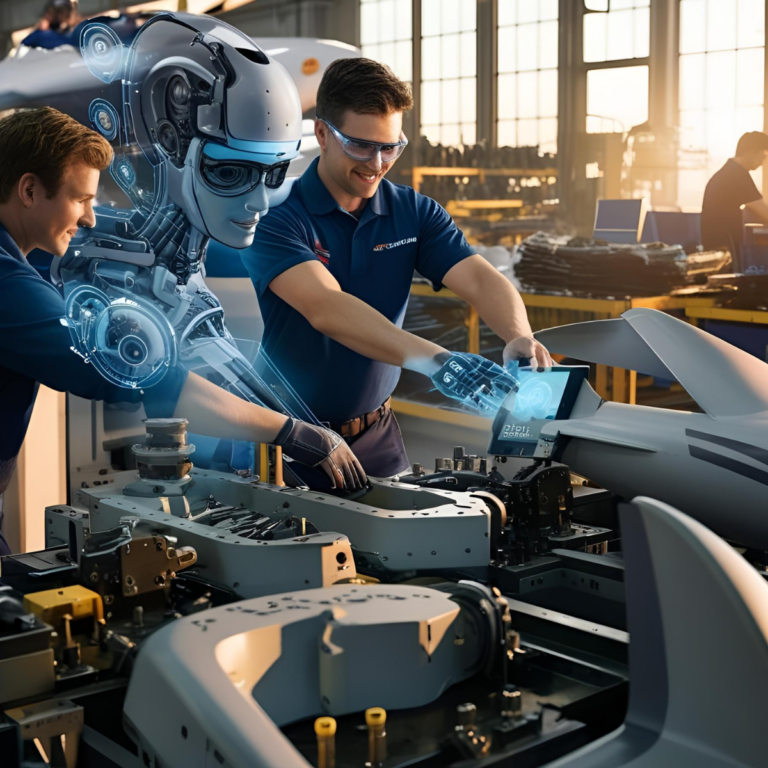
In operational environments—especially manufacturing, logistics, and aerospace—the impact is even more profound.
Training is no longer about:
- Delivering content
- Running workshops
- Measuring attendance
It is about:
- Improving execution
- Reducing variability
- Embedding standards into daily work
This is where AI becomes a multiplier.
How AI Is Transforming Training in Practice
AI-driven training systems are enabling:
1. Real-Time Coaching
Operators and managers receive guidance directly in the flow of work, not in a classroom.
2. Microlearning at Scale
Short, targeted learning modules tailored to roles and tasks improve retention and engagement.
3. Intelligent Support Systems
AI tutors and assistants provide immediate feedback, accelerating learning cycles.
4. Data-Driven Development
Training is no longer based on assumptions—it is driven by real performance data.
Measurable Business Impact
Organizations adopting AI-driven training are already seeing:
- 44%–87% increases in engagement and satisfaction
- Faster skill acquisition and onboarding
- Reduced training costs and administrative overhead
- Improved retention and operational consistency
Most importantly:
Training starts impacting performance—not just knowledge
The Strategic Shift: From Training to Capability Building
The real transformation is not technological—it is philosophical.
Leading organizations are moving from:
👉 Delivering training programs
to
👉 Building continuous improvement systems
This means:
- Learning is embedded in daily operations
- Leaders act as coaches, not supervisors
- Knowledge becomes structured, accessible, and scalable
Final Thought
AI and digital skills are no longer optional capabilities—they are foundational elements of competitive organizations.
The companies that will lead in the coming years are not those that train more.
They are those that learn faster, adapt continuously, and execute better.