
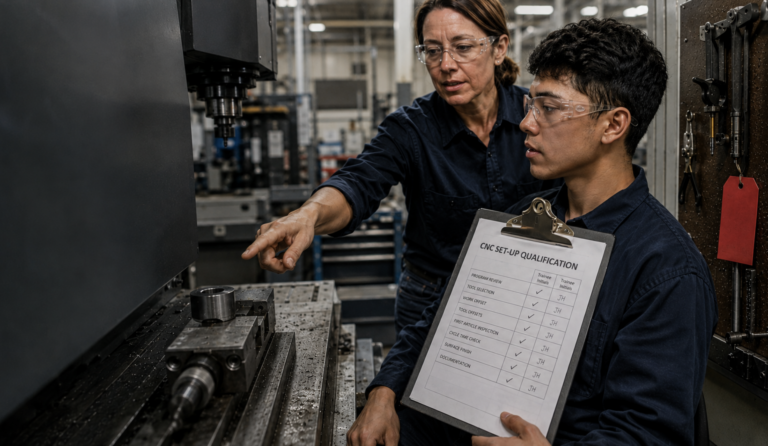
The trainer stood two steps behind the new hire, arms crossed, and stepped in four times in twenty minutes. Not for anything dramatic. A fixture seated by feel before the clamp. A torque sequence run in an order the instruction doesn’t mention. A visual check the packet doesn’t contain. Each time, the same phrase: “That’s not in the sheet, but you have to do it.”
The new hire had been signed off two weeks earlier. The training matrix said qualified. The floor said supervised.
Direct answer first, because this is the question that brings people to this page: to reduce onboarding time in manufacturing, close the gap between the documented job and the real job — because every new hire is currently learning both, and the second one has no teacher except time.
How long does onboarding in manufacturing actually take?
The averages are worse than most plants admit. A new employee takes around eight months to reach full productivity; structured onboarding programs cut that to roughly five (SHRM data, via FirstHR’s 2026 benchmarks). Staffing-industry research published this July frames the first 30 days as the window that decides whether a production hire stays at all, and pushes time-to-competence — not training-completion percentage — as the KPI that matters.
Now put that against the demand side. Deloitte and the Manufacturing Institute project the US needs up to 3.8 million manufacturing workers by 2033, and 1.9 million of those roles could go unfilled. Every month shaved off ramp time is capacity you do not have to hire.
The instinct is to buy more training: more modules, more videos, more sign-offs. But the eight-month number is not a training-volume problem. It is a content-accuracy problem.
Why new hires ramp slowly even with a training program
A new hire in most plants is learning two jobs.
The first job is the documented one — the qualification packet, the work instructions, the training modules. It has a curriculum, a schedule, and a sign-off at the end.
The second job is the real one — the fixture seated by feel, the torque order that actually works, the check the veterans run without thinking about it. This job has no curriculum. It is taught by whoever happens to be nearby, in fragments, corrected by scrap. It is the job the trainer was teaching in those four interventions.
The sign-off certifies the first job. Productivity requires the second. The distance between them is the extra three months — and the reason “qualified” people still need shadowing. The matrix is not lying, exactly. It is measuring paperwork completeness and calling it competence.
What actually shortens time-to-competence
The fix is not more hours against the current documents. It is making the documents contain the real job, so there is only one job to learn.
That means capture before curriculum. Sit with the people who run the station — operators, leads, the supervisor who covers breaks — and get the actual method out of their heads and into the procedure: the feel checks, the sequence that works, the recovery moves when something drifts. At SenseiLab we do this by having them talk directly to an AI agent that interviews them at the workstation and writes down how the job is actually done; the 30-day SOP Sprint turns those conversations into validated Living SOPs that live on a tablet where the work happens. When the procedure matches the floor, the new hire stops needing a translator.
You can test whether this is your problem without buying anything.
Run the two-jobs audit this week
Take one station. One hour.
- Pull its qualification packet and pick your newest signed-off person.
- Have them run the job strictly by the packet — nothing extra, nothing from memory.
- The trainer or lead watches silently and keeps a tally: every time they would normally step in, that’s one mark.
- Count the marks. Each one is a step that lives in someone’s head instead of the document.
Zero to two marks: your documents are close; your ramp problem is elsewhere. Three or more: your matrix certifies paperwork, and every new hire at that station is serving an unpaid apprenticeship in the second job. Multiply by your stations and your hiring plan for the fall, and you have the real size of the problem.
This audit is the one-hour version. The Sprint is the 30-day version: five to ten stations, captured, validated with the people who run them, and deployed where the work happens.
FAQ
How long does it take a new manufacturing hire to become fully productive? On average about eight months, though structured onboarding programs reduce this to around five months. The biggest lever is the accuracy of the procedures the hire trains against, not the volume of training hours.
Why do new hires take so long to ramp even with a training program? Because they are learning two jobs: the documented process and the way the work is actually done. Training programs certify the first; productivity requires the second, which is usually undocumented and taught informally.
How do you reduce onboarding time in a manufacturing plant? Capture the real method from experienced people first, then train against that. When work instructions match what the floor actually does, new hires learn one job instead of two, and time-to-competence drops measurably.
Before your next hiring wave
Book a 30-minute SOP Readiness Diagnostic and we’ll walk one of your stations through the two-jobs audit together.
senseilab.io/book-a-call
Diego Echenique is the CEO and co-founder of SenseiLab. He has spent 20+ years in manufacturing operations — launching plants, leading operations, and running Lean and Six Sigma transformations across automotive, mining, and heavy industry on five continents.