There was an operator I worked with years ago who could tell when a batch was going wrong by the sound the process made before any gauge moved. Ask him to explain it and he would say, “you just learn it.” When we sat him down to document his method, he gave us a clean, sensible procedure. Every step was correct. And the procedure was missing the one thing that actually made him good, because he did not know it was a step. To him it was just listening.
I have thought about that operator a lot this year, because the whole industry is now buying tools that promise to do exactly what we tried to do with him, at scale, with AI. Record the expert, transcribe the knowledge, generate the SOP. And the tools are good at the thing they do. They are just not doing the thing the marketing says they are doing.
This is not a one-operator story
That gap between what an expert can describe and what an expert actually does is in every plant I have ever walked. There is the version of the process the person can put into words, and there is the version their hands run. The first one is the interview. The second one is the work. They are never quite the same, and the difference is usually the part that matters, the feel, the early warning, the small correction made before anyone else would notice a problem.
For decades that gap was tolerable because the knowledge transferred slowly, person to person, on the floor, over years. It is less tolerable now, and the reason is demographic. 26% of the manufacturing workforce is over 55, and 82% of recent manufacturing departures are retirement-driven, with the Manufacturing Institute projecting up to 1.9 million roles potentially unfilled (Litmos, 2026). The people who carry the second version of the process are leaving faster than the floor can absorb what they know. That is the real urgency, and it is why the AI-capture wave exists at all.
The wave is real, and so is the assumption hiding inside it
Deloitte’s 2026 Manufacturing Outlook puts AI at the center of how manufacturers will compete, and knowledge work is high on the list. As of last week, South Korea launched a national program to turn master workers’ know-how into AI training data (UPI, June 12, 2026). The ambition is correct. Capturing what is in our experts’ heads before it walks out the door is one of the most important problems in manufacturing, and I am glad serious money and serious governments are pointing at it.
But almost every tool in this category is built on one quiet assumption: that capture equals transcription. That if you record the expert clearly enough and let a good model write it up, you have captured the knowledge. You have not. You have captured the narration. And the narration is the part the expert can already articulate, which is, by definition, not the hard part.
Why the transcript misses the center
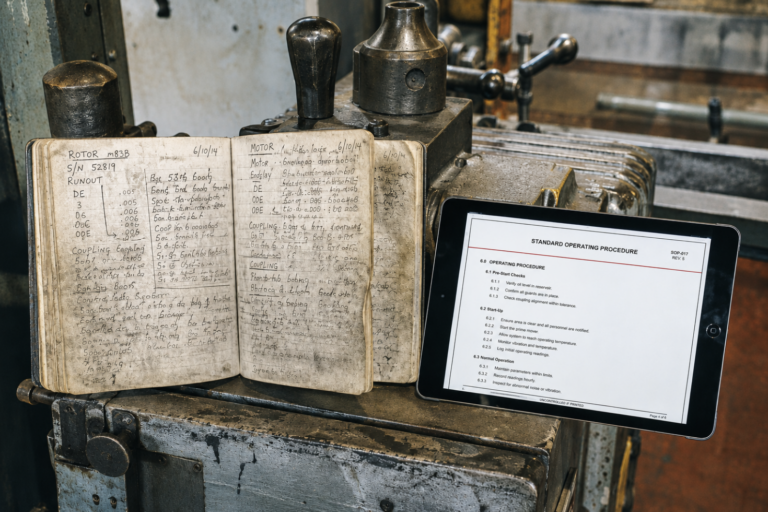
Tacit knowledge is tacit precisely because it resists words. The expert is not hiding it. He genuinely cannot tell you the thing he does by feel, because he stopped consciously thinking about it twenty years ago. Ask him and you get the explicit method, confidently delivered, and an AI will render it beautifully. The result reads more polished than the binder it replaces, which is exactly what makes it dangerous. Nobody audits a document that reads that well. It looks finished. It is missing its center.
This is the same crack I spent the week describing in three different disguises. Earlier this week I wrote about defects closed as “operator error” when the operator was following an unclear procedure. And about the SOP binder sitting three revisions behind the floor while everyone trusts it. Now the AI transcript that captures the words and misses the move. Three symptoms. One cause. The real process was never observed and validated, only described. Documented, but not captured.
Defects, audit findings, and lost expertise are not three separate problems with three separate tools. They are what an undocumented real process looks like from three different angles.
What actually captures it
The thing that closes the gap is not a better recorder. It is observation plus validation. You watch the work, not just the interview. You capture what the expert says and what the expert does, especially the parts he never narrates. Then, and this is the step almost everyone skips, you validate the captured method against the output. You confirm that the procedure you wrote down is the one that actually produces the good part, not just the one the expert was comfortable describing.
AI belongs in this. We use it heavily at SenseiLab. But we point it at the work, not only at the conversation, and we keep a human in the loop who knows the floor well enough to notice when the expert did something his own description left out. The SenseiLab SOP Sprint is built around exactly this: 30 days on-site, watching the five to ten processes that matter most, capturing what is said and what is done, validating it against the output, and turning it into a living procedure your team can keep current. It is the scaled version of the exercise below.
Run this in your plant this week
You can test everything in this piece in under half an hour, with one operator and one task.
Record your best operator describing a critical task, start to finish. Let them give you the clean version.
Then go to the line and watch them do that same task. Mute the recording in your head. Write down every action they take that they did not mention, every pause, every check, every adjustment by feel. The length of that list is your tacit-knowledge gap on a single task, measured in real steps rather than vague worry.
Now scale the worry into a number. Count the critical processes in your plant that depend on one person. For each, estimate the days of feel and judgment that person carries that are written down nowhere. Multiply. That product is your institutional knowledge expressed as risk, and it is the number a recording tool alone will not reduce, because it cannot capture what the expert never says.
The wave is real. The retirement clock is real. The knowledge your best people carry but never narrate is real. A recorder will capture the part you were never going to lose. The part you are actually losing is the part you have to go to the floor and watch.