Every plant has run this experiment. Hand the most experienced person a blank SOP template, give them two weeks, and get back one page that any second-year hire could have written. The program stalls, the binder gets its update stamp, and the real process keeps living where it always lived: in one person’s hands.
Manufacturing knowledge capture fails at the first step in most plants, and it fails for a reason almost nobody names. The expert is not refusing to share. The expert cannot see what they know.
Why can’t experienced operators document their own procedures?
The philosopher Michael Polanyi put it in six words: we know more than we can tell. California Management Review built its March 2026 argument on that line, calling tacit knowledge “your next competitive moat” — the judgment your best people carry is the one asset competitors cannot buy or copy. (Outbound: California Management Review, March 2026.)
Here is the mechanism. Skill automates with repetition. The check a machinist ran consciously in year two runs below awareness by year twenty. When you ask him to document the job, he writes down the steps he still thinks about — which are exactly the steps a novice also thinks about. The judgment that separates him from the novice is no longer visible to him. It is not a step. It is just how the job feels.
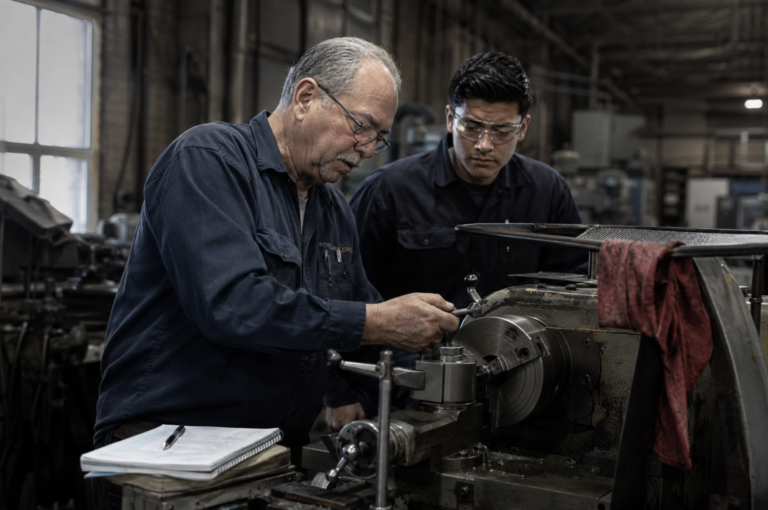
We watched this play out in a capture session recently. A veteran machinist handed back one page. Our AI agent interviewed him at his station and the transcript ran eleven steps longer, including a check he does by ear before every first run. He never wrote it down because he never thought of it as a step.
The better someone is at the job, the worse they are at writing it down. That is the expertise paradox, and it is why self-documentation programs quietly die in every plant that tries them.
Why knowledge management software doesn’t solve it
The category answer to knowledge loss is software: wikis, document platforms, video libraries, AI tools that generate an SOP from a prompt in minutes. All of them share one assumption — that the knowledge arrives typed. A template collects what the expert thinks is worth saying. A prompt-generated SOP documents what the prompter believes. Neither can collect what the expert never thought to mention.
This is not a software problem. It is an extraction problem. The stakes are not small: nearly a third of the manufacturing workforce is over 55, and manufacturers are spending a record $31.9 billion a year on training (Manufacturing Institute, 2026) — training built, in most plants, from documents the experts wrote about their own blind spots.
How do you capture tacit knowledge? Ask the questions the expert can’t ask themselves
Tacit knowledge does not survive a blank page, but it surfaces reliably under the right questions. Not “how do you do this job” — that gets you the one page. The questions that work aim underneath awareness:
What do you check before you start that is not on the sheet? What do you listen for, or feel for, while it runs? What tells you it is about to go wrong, before any gauge shows it? What would a new person get wrong in their first week? When the part comes out bad, what do you try first — and why that first?
Ask a furnace operator these questions and you learn he reads flame color before he trusts the thermocouple. That was never in a binder. It was never going to be.
Three rules make the interview work. Run it at the workstation, not in a conference room — the equipment prompts memory the way a blank page cannot. Take answers verbatim — the operator’s own words carry calibration (“until it stops ringing”) that paraphrase destroys. And treat every “oh, that’s nothing, you just…” as the headline — that phrase is where the tacit knowledge lives.
This is the mechanism SenseiLab is built on. Operators talk directly to our AI agent at the workstation; the agent asks the questions above and structures the answers into a Living SOP that is validated with the supervisor and keeps evolving as the process does. The interviewer never gets bored, never assumes, and never skips the follow-up question. The operator never has to face a blank template.
Run the one-page test in your plant this week
You can measure your own gap without any platform. Pick one critical station. Give your best person a blank template and thirty minutes to document the job, no help. Then have a supervisor watch them actually run it, and tally every action, check, and adjustment that is not on the page.
That tally is your capture backlog for that station. Multiply by the stations that matter and you have the honest size of the problem — usually about 70% of what actually runs the plant.
Then run the five-question interview from the section above on the same person and compare what comes back against the template. The difference is not effort. It is method.
FAQ
What is tacit knowledge in manufacturing? Tacit knowledge in manufacturing is the experience-based judgment that guides skilled work but is not written in any procedure — what an operator listens for, feels for, and adjusts without thinking about it. It typically accounts for the majority of what separates a veteran from a trained novice.
Why can’t experienced operators document their own procedures? Because expertise automates with repetition, the most critical checks run below the expert’s own awareness. When asked to self-document, veterans write down the steps they still consciously think about, which are the steps a novice already knows. The judgment stays invisible to its owner.
How do you capture tacit knowledge before workers leave? Through structured interviews at the workstation, not blank templates. Questions like “what do you listen for while it runs” and “what would a new hire get wrong” surface knowledge the expert never thought to write. AI agents can now run these interviews directly with operators and structure the answers into living procedures.
Author bio block
Diego Echenique is the CEO and co-founder of SenseiLab. He has spent more than 20 years in manufacturing operations, launching plants and leading Lean and Six Sigma transformations across automotive, mining, and heavy industry on five continents.