
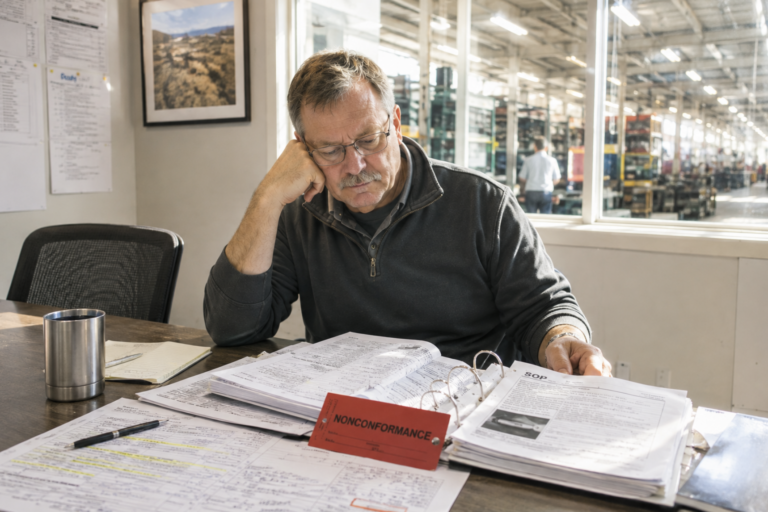
The auditor doesn’t say it with any drama. She just reads the finding, then adds the sentence everyone in the room already feels coming: “This was also observed in the previous audit.”
Same clause. Same station. The corrective action from last year sits in the system, closed, with a revised SOP and a signed training record attached. And the finding came back anyway.
That is not a quality-team failure. It is the clearest data point your plant produces about why SOPs fail on the shop floor — and most management teams read it wrong.
This isn’t one bad audit. It’s what “closed” means in your system.
The Q1 2026 auditor roundup from The FDA Group puts a number on it: around 40% of repeat inspection observations tie back to document control, training evidence, and procedural compliance. Zamann Pharma’s 2026 GMP analysis lands in the same place — 60 to 65% of FDA 483 observations link to training deficiencies, documentation issues, and weak execution systems, with poor alignment between SOPs and real practice called out as the risk inspectors chase hardest.
Read those numbers slowly. The most common audit finding in regulated manufacturing is, in effect, the paper doesn’t match the floor. And the most common repeat finding is it still doesn’t.
Why the fix updates the paper and not the practice
Here is the loop, and if you work in a regulated plant you have watched it run.
A finding lands. The clock starts. The corrective action has to be documented, auditable, and closed by a date — so it takes the only shape that fits those constraints: revise the SOP, retrain the staff, file the evidence. A quality engineer rewrites the procedure at a desk, usually by adding the missing control the auditor flagged. The revision gets approved by people who also do not run the job. Training is a sign-off. The CAPA closes on time.
Meanwhile, at the station, the job keeps running the way it actually works — the way some operator figured out years ago, the version that produces good parts, the version that was never captured. The revised SOP made the document more compliant and less true at the same time. Operators now follow it less, not more, because it drifted further from the real method.
Nothing in that loop ever touches the way the work is physically done. The system closed a document. The auditor audits the floor.
What this looks like from the floor
A torque spec gets flagged because three operators pull to feel, not to the number. The fix adds a torque-verification step to the SOP. The operators keep pulling to feel — the spec was written for a fixture the plant replaced two years ago, and their feel is what actually holds.
A changeover finding closes with a revised setup sheet. The weekend shift never sees it; their version lives on a laminated card the best setter made himself, and it is better than the official one.
A logbook finding closes with retraining on documentation practices. The entries do not improve, because the entries were never the problem — the procedure asks operators to record a reading the current control panel no longer displays.
Three closed findings. Three untouched realities. Three return dates.
The category sells audit prep. The audit keeps finding the floor.
Compliance software measures document currency: revision dates, approval chains, training matrices, review cycles. All of it can be green while the procedure describes a job nobody does. Audit-prep consulting polishes the binder before the inspector arrives. Document control tightens who can edit the fiction, not whether it is fiction.
None of these tools ask the only question the repeat finding is raising: is the written method the real method? A procedure captured from the people who run the job is the only durable answer. This is what we build at SenseiLab — operators talk directly to our AI agent about how the job actually runs, the output is validated on the floor with the supervisor, and the Living SOP keeps evolving as the process does. When the document is true, closing a finding against the document and closing it on the floor become the same act. The 30-day SOP Sprint exists to get a plant’s critical procedures to that state before the next audit cycle, not after.
Run the repeat-finding autopsy this week
Pull your last three repeat findings. For each, answer one question in three columns: after the first closure, what changed — the document, the training record, or the way the job is physically done?
If the third column is empty across all three, your corrective-action system is functioning as a document-editing system. That is not a character flaw; it is what the closure clock incentivizes. But now you know what the auditor knows.
Then take one revised SOP to its station and watch one full cycle against it, silently, counting deltas. Fifteen minutes. The count tells you whether your next audit already has a repeat finding scheduled.
The 40% is real. The closed CAPA that touched nothing is real. The return visit is real.
Unless the next revision is captured from the floor instead of written at a desk.
FAQ
Why do the same audit findings keep coming back? Because most corrective actions close against documents, not practice: the SOP gets revised at a desk and training gets re-signed, while the way the job is physically done never changes. Auditor data from 2026 shows roughly 40% of repeat observations tie to document control, training evidence, and procedural compliance.
Why do SOPs fail on the shop floor even after revisions? Because revisions written away from the floor typically add controls without capturing the real method, so each revision makes the document more compliant and less accurate. Operators follow procedures less as the gap between the written method and the working method grows.
How do you close the gap between SOPs and actual practice? Capture the procedure from the people who run the job — through structured interviews at the workstation — then validate it on the floor and keep it living as the process changes. When the written method is the real method, document fixes and floor fixes become the same fix.
Author bio block
Diego Echenique is the CEO and co-founder of SenseiLab. He has spent more than 20 years in manufacturing operations, launching plants and leading Lean and Six Sigma transformations across automotive, mining, and heavy industry on five continents.