I still remember the smell of that airport.
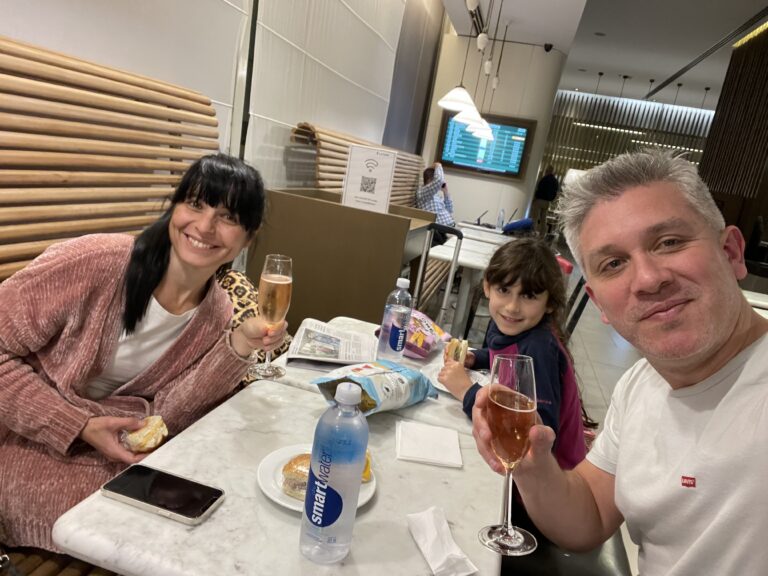
Not the jet fuel, not the recycled air, not even the coffee from the terminal kiosk. What I remember is that particular mix of exhaustion, excitement, and something that I can only describe as the specific weight of not knowing what comes next. Four years ago today, Liza and I landed in the United States with our daughter, our dog, and two suitcases each. That was it. That was everything we decided we needed. We hadn’t come as tourists. We hadn’t come to visit. We had come because this country — this impossibly complicated, endlessly generous, permanently improbable country — had said yes to us.
And when the United States says yes, you don’t walk through that door. You run.
What It Means to Start Over — and Why We Chose Florida’s Manufacturing Sector to Do It
There’s a word in Spanish — arraigo — that doesn’t translate well into English. It means something close to rootedness, but that’s not quite it. It’s the sense of belonging so deeply to a place that the place becomes part of you. Liza and I know what that feels like in multiple languages. We built a life together across three countries before we ever boarded a flight to Miami — in Argentina, where our roots run deep; in New Zealand, where we first learned what it feels like to be the foreigners who have to earn their place; and in France, where Liza poured herself into her academic work and I learned that the best industrial operations in the world don’t happen by accident. We had worked hard on four continents between us. We had loved the places that shaped us. We had carried those places with us every time we moved.
And then we looked at each other across a kitchen table in Buenos Aires and asked: what if we took all of that — every bit of it — and put it somewhere that was truly ready for it?
Coming to the United States wasn’t just a professional move. It was a decision made late at night, with our daughter asleep, with coffee going cold between us while we talked about what we actually believed in — about work, about education, about the kind of people we wanted her to watch us become. We believed that manufacturing — real manufacturing, the kind where humans solve hard problems and build things that matter — deserved better tools, better thinking, and better support than it was getting. We believed the marine industry deserved it. The aviation industry deserved it. And we believed, maybe naively at the time, that Florida was the place where we could do something meaningful about it.
Four years later, I can tell you: we weren’t naive. We were just early.
The People Behind SenseiLab: Two Backgrounds, One Shared Obsession
People sometimes ask what made us think we could build something like SenseiLab. I always want to give a clean answer — a founder story with a single turning point, a eureka moment. But the truth is messier and, I think, more honest than that. SenseiLab was not born from a pitch deck. It was born from a pattern that both of us had watched repeat itself, on different continents, in different industries, for more than two decades combined.
Liza came to this with a mind trained in places that don’t tolerate shortcuts. She holds a PhD and an MBA, and she has stood in front of classrooms at the University of Oxford, at La Sorbonne in Paris, at the University of Auckland in New Zealand, and at the Universidad Torcuato Di Tella in Buenos Aires. These are not names dropped for effect — they represent twenty years of thinking rigorously about how organizations learn, how knowledge moves through institutions, and what happens when it doesn’t. But Liza is not only an academic. She has deep, hands-on operational experience in the marine industry — work that started in Argentina and continued right here in Florida. She knows the maritime sector from the inside: how marine companies operate under pressure, what they consistently fail to document, and what happens when critical operational knowledge exists only in the minds of the people on the water rather than in the systems of the company on the shore. She has spent her career at the intersection of how organizations learn and how real industries actually work. She is, in the best possible sense of the word, a builder — not of machines, but of the systems that ensure the knowledge behind those machines never disappears.
I — Diego — hold a degree in Logistics and an MBA, and for more than twenty years I have worked inside the supply chains, operations, and production systems of companies across Argentina, Chile, Europe, the Middle East, and Asia. I have always been drawn to manufacturing — to being where the real value for a company is actually created. When I worked for Renault Nissan in Europe, I had the opportunity to visit supplier plants across multiple countries. And what struck me every single time — in every language, in every facility, regardless of the technology, the budget, or the size of the operation — was that the difference between a plant that worked and one that struggled was never the machinery. It was always the culture. The way knowledge was shared or quietly hoarded. The way processes were documented or left entirely to memory. The way experienced people either passed what they knew down the line, or took it with them the day they left. I saw that same pattern repeat itself from Argentina to Chile, from the Middle East to Asia, from European automotive suppliers to manufacturing floors on the other side of the world. The equipment changed. The people changed. The culture of knowledge — or the dangerous absence of it — was always the thing that determined everything else.
What Liza and I share is this: we have both watched, from different angles and on different continents, as manufacturing, marine, and aviation companies hemorrhaged the one thing that no capital investment can ever replace — the accumulated operational knowledge of their best people. And neither of us was built to just watch that happen.
Why Florida? Why Manufacturing, Marine, and Aviation? Why Now?
When we looked at Florida — really looked at it, past the beaches and the headlines — we saw something that most people outside the state were dramatically underestimating.
Florida is home to over 26,000 manufacturing companies employing more than 427,000 workers, and ranks among the nation’s top 10 states for manufacturing output. The aerospace and aviation corridor stretching from Miami through Orlando to the Space Coast is one of the most concentrated clusters of advanced manufacturing expertise in the entire Western hemisphere. Florida ranks No. 2 in the United States for manufacturing job growth, with 19 commercial-use airports, 14 deepwater seaports, and the second-largest foreign trade zone network in the country. Global manufacturing leaders — Lockheed Martin, Jabil, Saft, and hundreds of others — have made Florida home.
And then there is the marine industry. Florida’s coastline is not just a postcard backdrop — it is one of the most significant marine manufacturing and marine services markets in the entire United States. Billions of dollars in marine production, repair, and operations flow through Florida ports and boatyards every year. This is a sector Liza knows from the inside, having worked in it professionally in Argentina and continuing that work here in Florida. The same knowledge retention crisis that is reshaping manufacturing and aviation is playing out with equal urgency across Florida’s marine industry — and almost nobody is talking about it yet.
Three industries. Three sectors where the stakes are high, the operations are complex, and the institutional knowledge that runs everything is dangerously underdocumented.
And that — right there — is exactly why we built SenseiLab.
The core belief we started with four years ago, and the one we hold even more firmly today, is this: the most valuable asset any manufacturing, marine, or aviation company owns is not its machinery, its real estate, or its contracts. It is its knowledge. The knowledge of how the work actually gets done. The knowledge inside the head of the technician who has been calibrating that same system for fifteen years. The knowledge embedded in a process that exists nowhere in writing because it was always just “the way we do it here.” That knowledge is fragile. It walks out the door at retirement. It disappears in a resignation. It evaporates in a restructuring. And when it is gone, companies feel it immediately — in quality failures, in costly rework, in onboarding that takes twice as long as it should, and in the slow, quiet erosion of everything that once made the operation work.
We didn’t come to Florida just to consult. We came to build something. We have developed a proprietary technology that we genuinely believe will change how manufacturing companies, marine operators, and aviation organizations across the United States capture, structure, and protect their operational knowledge. Documentation is not paperwork. Documentation is the living memory of an organization — and when that memory is built correctly, it becomes the foundation for training, for quality control, for scalable growth, and for the kind of operational resilience that no market disruption can take away.
The gap between what companies know and what they have actually documented is one of the most expensive, most overlooked problems in American industry today. That gap is exactly where SenseiLab operates.
Four Years of Building Something Real in Florida
I won’t pretend these four years have been simple. Starting a company is hard. Starting one in a new country, in a new professional ecosystem, while raising a daughter, keeping a dog happy in Florida heat, and simultaneously figuring out where to buy milk and what “HOA” means — that is a genuinely different kind of hard.
But here is what I know to be true: this country gave us an opportunity, and we have tried every single day to be worthy of it.
We have worked with manufacturers, marine companies, and aviation operators across Florida and the United States who were losing institutional knowledge faster than they could replace it. We have helped organizations realize that the answer to their training problems, their quality problems, and their operational scaling challenges was sitting right there — in the heads of their most experienced people — waiting to be captured, structured, and made permanent. We have had honest conversations with operations leaders who believed their biggest problem was recruiting new talent, only to discover that the real problem was that they had never properly documented what the talented people they already had actually knew.
And we have built the technology to do something lasting about it.
Florida is the most entrepreneurial state in the United States. We feel that truth every single day — in the people we meet, in the companies we work with, in the energy of a state that is genuinely willing to bet on people who show up with conviction and a plan. That willingness to try things, to build things, to back people with a vision — it is unlike anything we experienced anywhere else we have worked. And we are grateful for it in a way that is genuinely difficult to put into words without sounding like we are delivering a speech.
So instead, I’ll just say this: thank you, Florida. Thank you, United States. The door you opened four years ago is one we are still walking through every single day — and we intend to make the most of every step that remains.
What Comes Next for SenseiLab — and for Manufacturing Knowledge Management in Florida
SenseiLab is growing. Not in the way that startups talk about growth — the hockey-stick slides, the funding rounds, the press releases. We are growing the way the best manufacturing operations grow: methodically, with intention, building something that genuinely lasts.
We are expanding our work with Florida’s aerospace and aviation sector. We are deepening our roots in the marine industry — a space Liza knows from years of direct experience, and one where the need for structured knowledge documentation is as urgent as anywhere in American industry. We are continuing to develop and refine a technology that we believe will fundamentally change how companies in manufacturing, marine, and aviation think about what their people know, how to protect that knowledge, and how to transfer it before it walks out the door.
Because that is the mission. Not simply to help companies solve today’s operational problems — but to give them the tools to make sure that everything their best people know, every process, every hard-won insight, every workaround that actually works, is captured, structured, and made permanent. To make the knowledge of an organization as durable as the products it builds.
And we are doing all of this as a family — in every sense of that word. As partners. As co-founders. As parents who want our daughter to grow up watching us build something she can be proud of. As a team that believes manufacturing in Florida and across the United States is not in decline — it is in transformation. And transformation, handled with the right tools and the right intention, is an extraordinary thing to be part of.
Four years ago, we arrived with a dream, a daughter, a dog, and two suitcases each.
Today, we’re still here. Still building. Still believing.
And we are just getting started.
Frequently Asked Questions About SenseiLab
What does SenseiLab do? SenseiLab helps manufacturing, marine, and aviation companies in Florida and across the United States capture, document, and protect their operational knowledge — preventing the loss of critical institutional knowledge when experienced workers retire or leave.
Who founded SenseiLab? SenseiLab was co-founded by Diego and Liza. Diego holds a degree in Logistics and an MBA and has over 20 years of experience in manufacturing operations across Argentina, Chile, Europe, the Middle East, and Asia, including work with Renault Nissan. Liza holds a PhD and an MBA and has an academic background at Oxford, La Sorbonne, the University of Auckland, and Universidad Torcuato Di Tella, combined with professional experience in the marine industry in Argentina and Florida.
Where is SenseiLab based? SenseiLab is based in Florida, USA, serving manufacturing, marine, and aviation companies across the state and nationally.
What problem does SenseiLab solve? SenseiLab solves the operational knowledge retention crisis — the costly, largely invisible problem of companies losing the expertise of their most experienced workers without ever having properly documented it. The company has developed a proprietary technology platform designed to capture, structure, and protect that knowledge before it disappears.
What industries does SenseiLab serve? SenseiLab serves the manufacturing, marine (maritime), and aviation/aerospace industries, with a particular focus on Florida’s rapidly growing industrial sectors.
Is your manufacturing, marine, or aviation operation sitting on a knowledge problem you haven’t fully named yet?
We’d love to have a real conversation — not a sales call, not a pitch deck. Just two people who have lived these industries across four continents, talking with you about what your operation actually needs.
📍 SenseiLab | Knowledge Management for Manufacturing, Marine & Aviation | Florida, USA 🌐 www.senseilab.io
About SenseiLab: Co-founded by Diego and Liza, SenseiLab is a Florida-based technology company dedicated to helping manufacturers, marine operators, and aviation companies capture, protect, and transfer their most valuable asset — their operational knowledge. Through a proprietary knowledge management platform and deep industry expertise built across three continents, SenseiLab is building the tools that make an organization’s knowledge as durable as the products it builds.