
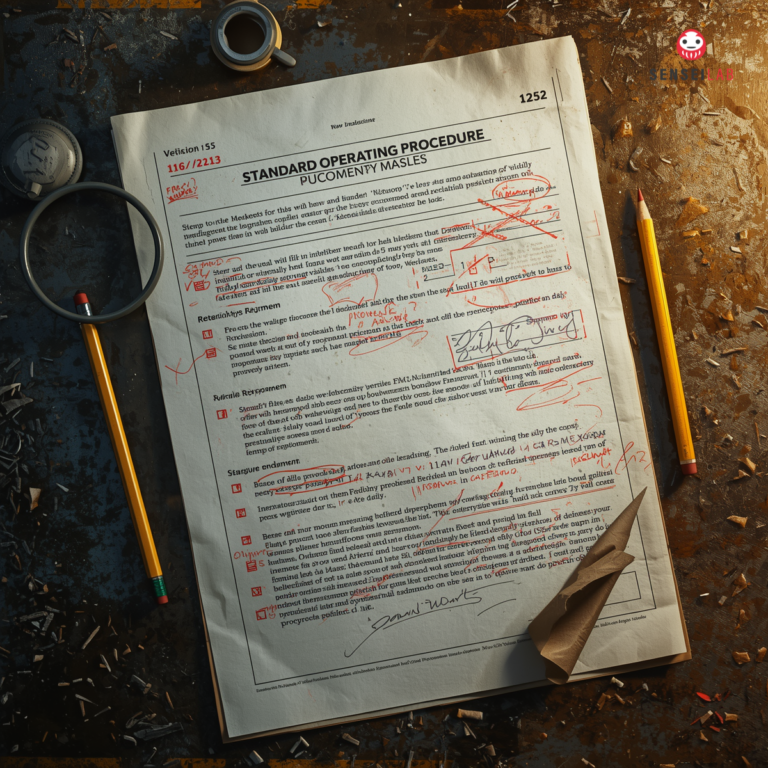
The plant manager will tell you the SOPs need an update. The QA director will tell you the SOPs need a revision cycle. The consultant will tell you the SOPs need to be migrated to a new platform.
All three are describing a symptom.
The actual problem — the one that explains why your last SOP rollout went the way it did, and why your next one will go the same way unless something changes — is that the procedures in your binder were never an accurate description of how the work gets done. They were a polite approximation, written by an engineer who watched the line for two hours and then wrote down what should happen. They got signed. They went into the binder. The audit passed.
And then Monday morning came, and the operators did what they have always done, which is run the line the way they actually know how to run it.
This is not a moral failing. It is not a discipline problem. It is not, despite what the next vendor will tell you, a “culture of adherence” issue. It is a basic, structural mismatch between how SOPs are written in most plants and how the work is done on the floor. The mismatch shows up on day one. Three revisions later, it has not gone away — it has just been formalized in three different ways.
The diagnostic question that matters is not “are our SOPs current?” The question is “were they ever true?”
I walked a refractory plant in the Midwest last quarter. Twenty-three signed SOPs. I spent two days on the floor. I picked three procedures at random and asked the operators running them to walk me through what they actually do, step by step. I did not show them the SOP first. I just watched.
On procedure one, the operator did six steps in a different order than the document specified. He could explain why for every reorder — he had reasons, and they were good reasons. On procedure two, three steps in the document had been silently dropped years ago because they were redundant with what the upstream process now did. On procedure three, the operator was doing something the SOP didn’t mention at all — a temperature pre-check on a panel with a known drift problem, which he discovered himself in 2019 and had been doing every shift since.
None of these were violations. Two of the three were improvements. The third was a safety-relevant workaround that should have been documented and trained the day it was invented.
But none of it was in the binder. None of it was in the software. None of it was on the wall.
This is not unusual. This is the median plant.
Why this keeps happening
The structural reason engineer-written SOPs miss the floor is simple, and once you see it you cannot unsee it. The engineer who writes the procedure has a model of the process. The operator who runs the procedure has the process itself. Those two things are never the same. The engineer’s model is a clean abstraction — what the equipment was specified to do, what the work instruction was designed to enforce. The operator’s process is the thing that actually works on a Tuesday at 2 a.m. when the temperature drifts and the upstream feed is two minutes late.
Both are real. Only one of them is in the binder.
Manufacturing has spent the last decade trying to close this gap with software. Every plant manager I work with has been pitched some version of “intelligent SOP” software, AI-assisted documentation, mobile-first work instructions, dynamic content. Some of these tools are useful. None of them solve the structural problem. Because if the underlying document was never accurate, putting it on a tablet does not make it accurate. It just makes it accurate on a tablet.
Gartner has documented this pattern at scale: 70% of digital transformations fail to meet their original business case. Across ERP, the failure rate is 55–75%. SOP software falls into the same category for the same reason — the technology layer cannot fix a content layer that never matched reality. You can deploy the best software in the world on top of a document that is wrong, and the operator on shift will quietly continue to do the thing he has always done, because the thing he has always done is the only thing that actually works.
The one step that fixes it — and the one step nobody runs
The step that fixes engineer-written SOPs is not a better template, a better platform, or a better training. It is a structured validation conversation with the operator who runs the procedure. Show me what you actually do. Tell me where this is wrong. Tell me what you’ve added that we never wrote down. Tell me what step we kept that you stopped doing five years ago.
This is the step every SOP software vendor skips. It is the step every consulting engagement quotes for and never delivers on. It is also the only step that produces a procedure that matches the floor.
McKinsey estimates that capturing this kind of operational knowledge properly — the floor-validated kind, not the engineered-from-a-desk kind — could unlock $100 billion in value across the industry, with 20–30% productivity gains in the workflows where tacit knowledge matters most: root cause investigation, maintenance, and supplier management.
This is the only problem we built SenseiLab to solve. Our 30-day SOP Sprint is a fixed-scope, fixed-price engagement built around the validation step every other approach skips. We go onto the floor, work alongside the operators, and produce 5 to 10 procedures that match what is actually being done — not what someone wrote down years ago and signed.
The honest test
There is one diagnostic you can run on your own plant this week. Pick one SOP. Pick the most experienced operator who runs it. Ask her to walk you through what she actually does, without showing her the document. Then compare.
If the answer is “they match,” you have a different operation than every plant I have walked in 20 years. If the answer is “they don’t match in three places, and one of those places is a safety issue,” welcome to the club.
The binder is not the procedure. The operator is the procedure. The work of a SOP Sprint is to make those two things the same thing.
If your SOPs and your floor have stopped matching — and you suspect they have — book a free 30-minute SOP Readiness Diagnostic. No deck. No pitch. Just an honest look at where the gap is and what it would take to close it.
Diego Echenique is the founder of SenseiLab, a knowledge-capture and operational-excellence firm working with regulated manufacturers across aerospace, marine, pharma, refractory, energy, and industrial fabrication. He writes weekly on Living SOPs, shop floor knowledge capture, and the gap between what your procedures say and what your plant actually does. http://www.linkedin.com/in/diego-echenique-40a9a425.