
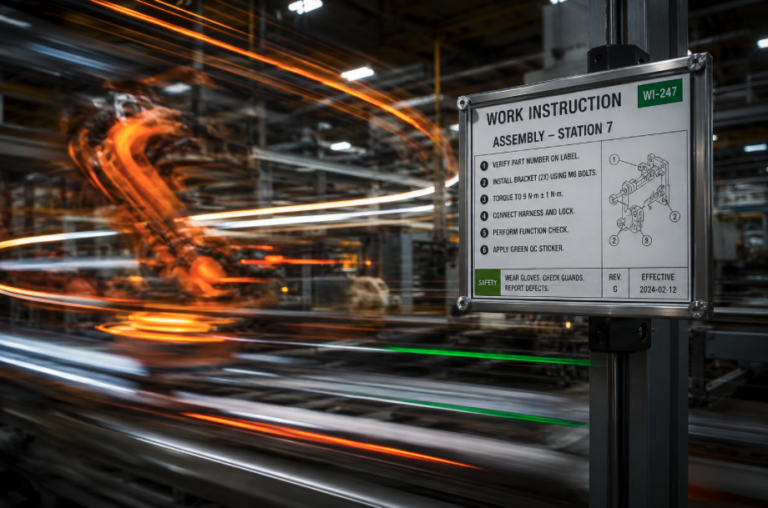
The SOP taped to the column lists twelve steps. The operator runs nine. The other three are the reason the line still makes good parts. That is not an indictment of the operator. It is the clearest sign you have of standards drift, and it is the single most common reason SOPs fail on the shop floor.
Living SOPs exist to close that gap. Not by writing a better document once, but by keeping the document and the work matched as the work changes. To understand why that matters, it helps to watch how the gap opens in the first place.
How a good procedure goes stale
Nobody decides to let an SOP drift. It happens one small, reasonable adjustment at a time.
An engineer writes the procedure before the line is fully tuned. The operator runs it a few hundred times and finds a faster sequence that holds the same tolerance. A fixture gets replaced and the new one seats differently, so a step changes. A material lot behaves slightly off, and the senior operator learns to compensate by feel. Each adjustment is correct. None of them makes it back to the paper, because the paper was never where the real work lived.
A year later, the document on the wall describes a plant that no longer exists. The line still runs, so no one questions it. That is the trap: the procedure earns its authority by not causing visible trouble, while the gap underneath it widens.
Why digitizing the document does not fix it
The loudest conversation in manufacturing right now is digitization. Connected frontline workforce platforms, digital work instructions, point-of-need guidance on a tablet. According to LNS Research, more than 25% of manufacturers have adopted connected frontline initiatives and over half have deployed some form of digital work instruction.
This is genuine progress. It is also a trap if you skip a step. Digitizing a procedure that was never accurate does not make it accurate. It makes the wrong procedure load faster, render cleaner, and look more authoritative on a screen. The operator who used to ignore the binder now ignores the tablet, except now the gap is harder to see because the interface looks current.
Speed of access is not the bottleneck on most floors. Accuracy of content is. A digital instruction that no one validated against the work is just standards drift with a better display.
What standards drift actually costs
The cost is structurally invisible, which is why it survives. It does not appear on the P&L as “our procedures no longer match the work.” It appears as scrap, as rework, as a quality finding attributed to a training opportunity, as a new hire who takes eight months to reach the output the role was hired for.
The aggregate is not small. ASQ puts quality-related costs at 15 to 20% of sales for a typical manufacturer, with cost of poor quality ranging from 10 to 30% of revenue. Its 2025 Cost of Quality report found that only 31% of organizations fully understand how those costs reach their financials. You cannot manage a number you cannot see, and you cannot see the cost of a procedure you have never observed being run.
Run this on your floor this week: the three-column drift audit
This is the five-minute version of the work, and you can do it without hiring anyone.
Pick one SOP for a process that matters. Make a simple three-column sheet. Label the columns: Document says, Operator does, Why the delta exists.
Now stand at the station for one full shift, not thirty minutes. Watch the procedure run. Every time the operator’s hand departs from what the document says, write the document’s version in column one, what actually happened in column two, and ask the operator why in column three.
Three things will become obvious by the end of the shift. First, how many deltas there are. More than three on a single procedure and the document is fiction. Second, that most deltas exist for good reasons the operator can explain in one sentence. Third, that none of those reasons are written down anywhere in your quality system. Column three is the tribal knowledge that walks out the door at retirement. Column two is your real procedure. The document on the wall is just the last time someone wrote it down.
From a one-shift audit to Living SOPs
The audit shows you the gap on one procedure. Closing it across the five to ten procedures that actually run your operation is the harder problem, and it is the one the SenseiLab SOP Sprint was built to solve. The Sprint puts a Lean practitioner and an AI capture process on the floor next to your operators for 30 days, captures what actually works, validates it with the people doing the job, and turns it into Living SOPs that stay current as the process evolves and live at the workstation where the work happens.
The difference between an SOP and a Living SOP is not the format. It is whether anyone is keeping the document matched to the floor. Do that, and digitization finally has something true to display.
About the author
Diego Echenique is the CEO and co-founder of SenseiLab, where the team captures the knowledge that actually runs manufacturing operations and turns it into Living SOPs. He has spent more than two decades in manufacturing operations across the Americas, Europe, the Middle East, and Asia, in refractory, mining, and industrial production.
Sources
- ASQ — Cost of Quality. COPQ 10–30% of revenue; quality costs 15–20% of sales. https://asq.org/quality-resources/cost-of-quality
- ASQ — 2025 ASQE Insights on Excellence Cost of Quality Report. Only 31% of organizations fully understand quality-cost impact. https://asq.org/quality-resources/benchmarking/2025-asqe-insights-on-excellence-cost-of-quality-report
- LNS Research — Connected Frontline Workforce (April 2026). 25%+ adopted, 50%+ deployed CFW solutions. https://blog.lnsresearch.com/why-are-cfw-applications-becoming-manufacturings-must-have-solution