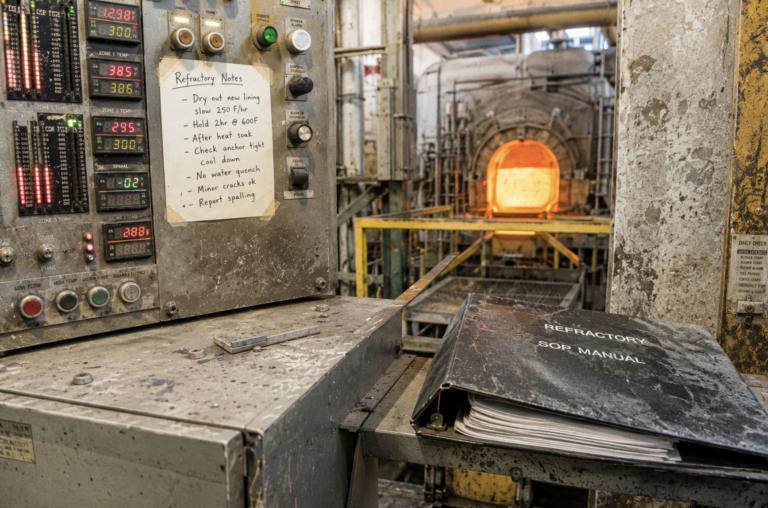
Raymundo had run the tunnel kiln at a refractory plant for 29 years. He could tell the mix was drifting from the sound of the burner, a half-shift before the panel showed it. When he retired, nobody wrote that down.
The plant thought it had a staffing problem. It had a knowledge problem, and the two look identical right up until the day the good operator is gone.
This is not a Raymundo story. It is the same story in every plant I have walked, on three continents, for twenty years. The best-run job on the floor is almost always the one that lives in one person’s hands, and almost never the one that is actually written down.
The number a Deloitte report just put on it
Last week Deloitte and eGain published research they called The $9 Trillion Knowledge Exodus. Over the next four years, more than 30 million Americans will turn 65, in what the authors describe as the largest single transfer of institutional knowledge in business history. The projected cost in lost output is $6.9 to $9.6 trillion.
The number that should stop a plant manager cold is not the trillions. It is this: 92% of the organizations they surveyed still capture none of it consistently before the person leaves. Nearly everyone sees the wave coming. Almost no one is doing the one thing that would blunt it.
That gap between awareness and action is the whole problem, and it is not a budget problem. It is a misunderstanding of what “capture” actually means.
Why the knowledge was never written down in the first place
Every plant has an SOP binder. The binder holds the explicit part of the job, the part someone could sit at a desk and type: the setpoints, the sequence, the sign-offs. Call it the 30% that is easy to say out loud.
The other 70% is tacit. It is the sound the burner makes when the mix starts to drift. It is the feel of a setup that is about to walk out of spec. It is the second-guess your best operator makes at 2 a.m. that nobody else on the floor knows to make. None of it is written down, because none of it is easy to say. It only comes out when someone sits next to the operator while the job is running and asks the right question at the right moment.
That is why most “knowledge capture” fails. It gets handed to someone with a template and treated as a documentation project, done in a conference room, away from the machine. A template can only catch what the operator already knows how to explain. The 70% that runs the line does not survive the trip to the conference room.
Why “we’ll capture it with AI” skips the only hard part
The comfortable answer in 2026 is that generative AI will handle it. Point a model at the binders, auto-generate the procedures, and move on. I understand the appeal. It is also half an answer.
GenAI can only structure what a human already observed and wrote down. Point it at a binder that holds the explicit 30% and you get a faster, cleaner version of the 30%. The tacit 70% is in no document for the model to read. It is still in one pair of hands. Aim AI at a procedure that was already incomplete and you get a more confident version of an incomplete procedure, which is worse, because now it looks finished.
McKinsey, in its 2025 work on the manufacturing workforce, frames the fix plainly: capture and codify the critical knowledge that is at risk, at the source, with the people who hold it. The tools help once the observation has happened. They cannot replace it.
What this actually costs while you wait
The math underneath the retirement wave is not abstract. Deloitte and the Manufacturing Institute project up to 3.8 million manufacturing roles needed by 2033, with as many as 1.9 million potentially going unfilled. Every skilled operator who leaves without a captured method is not one resignation. It is a job that now takes longer to fill, longer to train into, and runs at higher variability until the replacement rebuilds, by trial and error, what the last person already knew.
You are not losing a headcount. You are losing a standard that never lived anywhere but in a person.
The market is selling you the wrong fix
Look at what is on offer. Better binders. Smarter search bars. An AI that summarizes documents that were never accurate to begin with. Every one of these improves how you store and retrieve the explicit 30%. Not one of them gets the tacit 70% out of the operator’s hands before they walk out the door.
The category has confused managing documents with capturing knowledge. They are not the same activity. One organizes what you already wrote down. The other goes to the floor and gets what you never did.
The shift
This is the only problem we built SenseiLab to solve. The 30-day SOP Sprint goes onto the floor, works next to your operators while the job is running, and captures the tacit layer, the sound, the feel, the 2 a.m. correction, then validates it against a second operator so it becomes a real standard instead of one person’s habit. That is manufacturing knowledge capture done where the knowledge actually lives, not in a conference room.
You do not have to start with us to start. You can start this week, for free, with a list.
Run this before the next quarter
Here is the exercise. Before your next shift review, list every operator with 15 or more years who can run a job nobody else runs clean. Next to each name, write the one thing they do that exists in no document, the setting they quietly correct, the failure they feel before they see it. That list is your real knowledge risk register, and it is more honest than any retirement-date spreadsheet HR is keeping.
Then take the top name and do the capture: sit one full shift with that operator, record the steps in their words including the why and the failure modes they feel rather than read, and validate it against a second operator before you file it. It is the cheap version of what McKinsey’s legacy-skills programs do at scale, and you can run it on one job before Friday.
The trillions are real. The retirement clock is real. The 70% you have never written down is real. When your Raymundo walks out the door, he takes it with him. Unless you capture it first.
Diego Echenique is the founder of SenseiLab and has spent 20+ years in manufacturing operations across the Americas, Europe, the Middle East, and Asia, leading Lean and Six Sigma work in refractories, automotive, and heavy industry.