
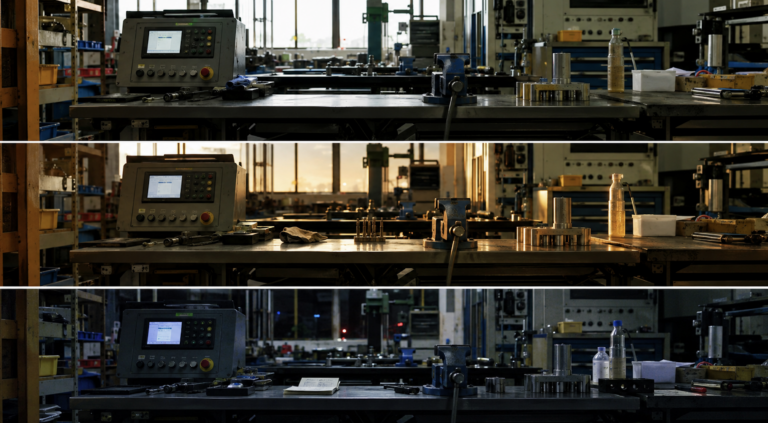
Day shift produces 1,200 units. Afternoon shift produces 1,150. Night shift produces 1,080. The production meeting attributes the variance to “third-shift staffing challenges” or “weekend material quality” or “preventive maintenance falling on Tuesday nights.” The variance has a different cause, and it is the cause no one in the meeting wants to name: shop floor SOP implementation has produced three different procedures, not one.
They are following the same SOP, on paper. In practice, the day shift runs it the way the supervisor showed them in 2019. The afternoon shift runs it with two informal modifications the most experienced operator on that crew made in 2022 to compensate for a known equipment quirk. The night shift runs it the way the senior person learned it, plus or minus whatever individual operators have improvised over the years.
All three are technically compliant with the SOP. None of them are doing the same job.
Why the cost of shift-to-shift variability hides
The cost of shift-to-shift variability is structurally invisible on most P&Ls. Industry analysis on constraint-line variability puts the cost at roughly $1,600 per hour of lost throughput on a single line — about $330,000 per year per line when you sum across small daily inconsistencies, and $1.3 million across four lines. That cost shows up as slightly lower output on certain shifts (attributed to staffing or scheduling), higher scrap rates at shift handover periods (attributed to material variability), more frequent minor quality issues on one shift than another (attributed to operator skill), higher overtime on the higher-performing shifts to make up for the lower-performing ones, and customer complaints that cluster around specific shifts (attributed to “training opportunities”).
Each of these is a real line item. None of them is labeled “the three shifts are not running the same procedure.” So the cost gets diffused, attributed elsewhere, and stays unaddressed.
Why manufacturing process standardization programs keep failing on this
Most plants have tried to fix shift-to-shift variability before. The standard playbook is well-established: identify best practices, document them, train all shifts on the documented best practice, audit for compliance.
The playbook usually works for a month. Then it stops working.
The reason it stops working is the same reason most SOP programs stop working. The “documented best practice” was usually identified from the day shift, often by a lead or supervisor who is not the operator running the procedure. It gets formalized into a document. The afternoon and night shifts are trained on it. They sit through the training. They sign the acknowledgment. They go back to the floor and continue running the procedure the way they always have, because the way they always have is the way that works on their shift, with their crew, with their upstream conditions.
The documented best practice is a description of the day shift. It is not a description of what works on the floor across all three shifts. Trying to enforce it as a universal standard does not produce universal practice. It produces three shifts that have learned to perform compliance when management is watching and revert to their actual procedure when management is not.
The three-shift observation framework you can run this week
Here is the diagnostic that surfaces the real variability picture. It takes about six hours spread across two days.
Step 1. Pick one critical procedure. Pick the one with the highest throughput impact or the one that recently produced an unexpected quality issue. Limit yourself to one procedure for this exercise — the temptation will be to expand to three or five, and you will get less out of it.
Step 2. Observe the day shift run the procedure. Stand close enough to see what the operator’s hands do. Record the procedure in your own words, step by step, as you watch. Do not bring the SOP with you. Do not let the operator know specifically what you are evaluating — just observe.
Step 3. Stay through the end of day shift and into the start of afternoon shift. Observe the same procedure on afternoon shift. Same approach — record what you see, in your own words.
Step 4. Return for the start of night shift, even if it means coming in at 10pm. This is the most important observation, because night shift is usually the most divergent from documented practice and the least visible to management.
Step 5. Lay the three transcripts side by side. Compare. Count the deltas between shifts, step by step. For each delta, ask three questions: is one method demonstrably safer than another? Is one demonstrably faster or higher-yield? Is one demonstrably better-aligned with the actual upstream and downstream conditions?
You will find three categories of deltas. Improvements — one shift has figured out a better way that should be the standard. Workarounds — one shift is compensating for a problem the others have not noticed yet. Drift — one shift has gradually slipped into a worse method that no one has corrected because no one has watched.
The output of the exercise is not a corrective action. The output is a clear picture of where your standard actually is — and where it is not. This is the same starting point we use inside the SenseiLab SOP Sprint, scaled across 5 to 10 procedures.
The structural fix is upstream of training
The structural fix for shift-to-shift variability is not training. It is producing a procedure that all three shifts genuinely agree describes the right way to do the work. That requires the operators from all three shifts to be in the room when the procedure is written, validated, and signed. Not informed of it after the fact. Not trained on it after a supervisor wrote it.
The procedure that emerges is one all three shifts had a hand in shaping, which is the only kind of procedure all three shifts will actually use. That is the foundation of Living SOPs — procedures the floor wrote and the floor will maintain.
Book a SOP Readiness Diagnostic for your variability
We bring representatives from all relevant shifts together. We document what each shift actually does. We surface the deltas. We negotiate a single procedure that incorporates the improvements, addresses the workarounds, and corrects the drift.
If your three shifts are quietly running three different procedures and you suspect the variability number is bigger than it appears on the P&L, book a free 30-minute SOP Readiness Diagnostic. We will walk through what the real exposure looks like and whether a Sprint would close it.
Author bio block
Diego Echenique is the founder of SenseiLab, a knowledge-capture and operational-excellence firm working with regulated manufacturers across aerospace, marine, pharma, refractory, energy, and industrial fabrication. He writes weekly on Living SOPs, shop floor knowledge capture, and the gap between what your procedures say and what your plant actually does.